
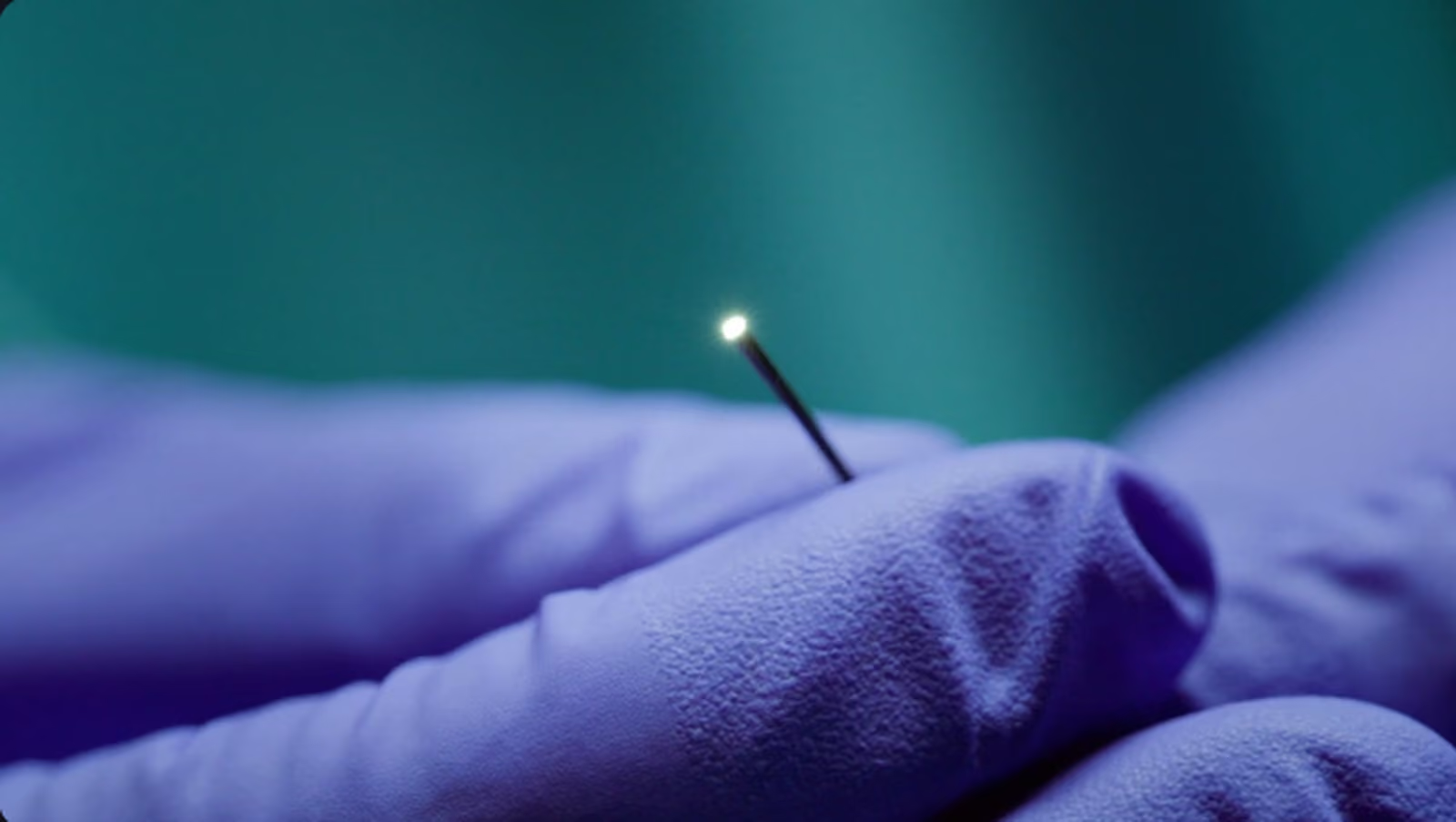
Every five minutes, someone in Canada has a stroke. For physicians, speed and precision are critical but until now, they’ve relied on external black-and-white X-ray images to guide treatment inside the body’s most delicate vessels.
Vena Medical, a Kitchener-based health-tech company founded by University of Waterloo, Velocity alumni Michael Phillips (BASc ’18) and Phillip Cooper (BASc ’18) is changing things. Their latest milestone: full Health Canada licensing for their Microangioscope, the first device in the world to provide full-colour, real-time imaging inside neurovascular, coronary and peripheral vessels.
We spoke with Michael Phillips about what this means for patients, hospitals and the future of stroke care. Read the recent announcement on NeuroNews International.
We recently received our Health Canada medical device license for the Microangioscope. Before this, physicians could only use it through special access cases which are one-off approvals from Health Canada. Now, they can use it as they see fit.
The big difference for patients is accuracy. Instead of relying on X-ray, physicians can see inside the blood vessel in full colour. That means better diagnoses, better therapies and fewer complications. If everything looks good inside the vessel, the patient hopefully never needs to come back for a follow-up because of an unexpected issue.
We’ve already done more than 30 cases across Canada from Sherbrooke to Vancouver. Training is straightforward: physicians start with simulations, then supervised use for a few cases. After that, they’re comfortable using it on their own.
One of the big innovations is size. Traditional endoscopy towers take up a lot of space and cost a fortune. We shrunk everything down to a small box—literally something you can hold in your hands. That makes it easy for hospitals to adopt quickly without major infrastructure changes.
The way I describe it is like driving with GPS versus looking out the windshield. X-ray is the GPS that gives you a map, but not the full picture. Our technology is like opening the window and seeing the road ahead. Physicians use both, but now they have that extra dimension of clarity.
We also apply what I call the ‘grandmother test.’ If my grandmother were a candidate for this procedure, would I want the physician using our device? Absolutely. My grandfather had a stroke before I was born. If this technology had existed then, maybe the 10 years I knew him would have been different.
Our original goal was to help physicians treat stroke better, identify the clot type and choose the right technique. But physicians are finding new uses, like locating the source of a stroke. About 30% of strokes are cryptogenic, meaning no one knows where they came from.
Now, while treating a stroke, physicians can check the carotid artery and decide if they need to implant a stent or adjust medication to prevent another stroke. One of our first patients had multiple repeat strokes. After using our device, the physician treated the source, and that patient hasn’t had a stroke in over a year and a half. That’s why we do this.
We’re focused on expanding indications and use cases over time. We have FDA breakthrough designation; the plan is to start with the U.S and then expand globally.
We’re also growing our team and bringing more manufacturing in-house and opening additional space at the Medical Innovation Exchange in Kitchener. It’s exciting to build this in Canada because there are so few companies here in interventional medicine. We want hospitals and patients to know this technology is available—and it’s Canadian.
Waterloo has incredible engineering and business talent. We don’t have a medical school, which is a challenge, but also an opportunity to partner with the best hospitals in Toronto and beyond.
I think the next big step will be programs that get engineers into hospitals to observe procedures and talk to clinicians. That’s how innovation happens. If we can make that easier, we’ll see even more medtech companies coming out of UW.
Velocity health companies are funded in part by the Government of Canada through the Federal Economic Development Agency for Southern Ontario (FedDev Ontario).