
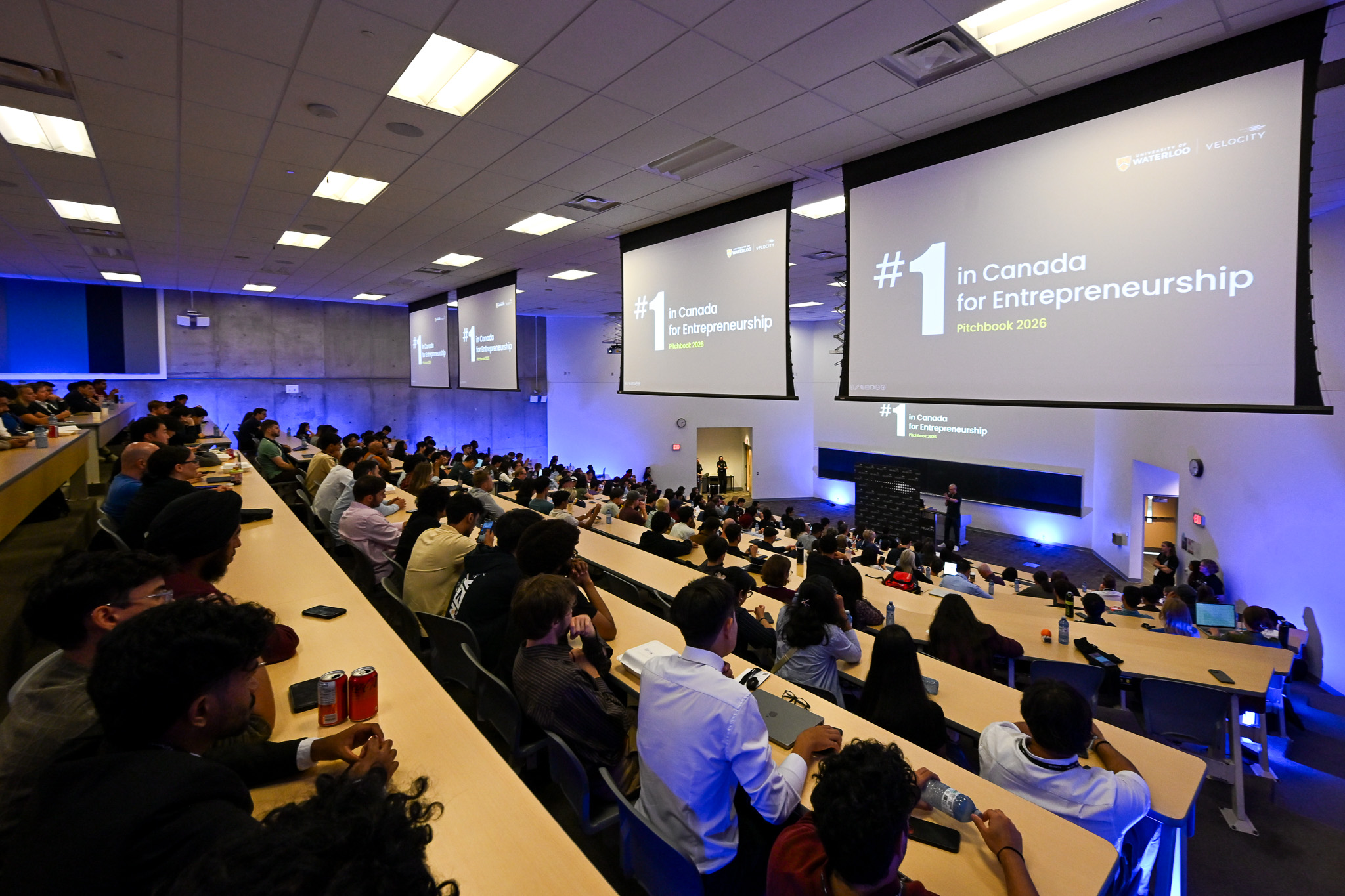
When founders step onto a pitch competition stage, they're often focused on perfecting a presentation, but according to some established and successful University of Waterloo entrepreneurs, the most important lessons come long before that moment.
After serving as emcees at the recent Velocity Pitch Competition, Connor Kapahi (PhD ’25) and Ibukun Elebute (MBET ’26, Conrad School of Entrepreneurship and Business) reflected on their own entrepreneurial journeys and the lessons they've learned from years of pitching, building companies and engaging with investors.

"Talk to your customers constantly," Kapahi says. "It's easy, especially for technical founders, to become obsessed with the solution, obsessed with the technology. If you want to build a successful business, you need to be obsessed with your customers."
Kapahi is founder and CEO of Mandel Diagnostics, a Velocity startup developing tools that help clinicians detect eye and brain diseases earlier. After winning the Velocity Pitch Competition in 2023, he has experienced firsthand how pitch competitions can help founders sharpen their message and prepare for future conversations with customers, partners and investors.
Understanding the problem is something Elebute, co-founder of CELLECT Laboratories, has also learned while building a company developing a non-invasive menstrual and gynecological specimen collection platform designed to make diagnostic testing more accessible.

"Stay close to the problem, not just your solution," she says. "The more deeply you understand the people experiencing the problem and the people who will ultimately pay to solve it, the better your decisions become."
For many early-stage entrepreneurs, pitch competitions for a chance to test how effectively they can communicate a business idea under pressure while receiving feedback from experienced judges and industry leaders. The challenge is learning how to cut through the noise.
Both founders say success often comes down to clarity.
"Decide the one thing you want the judges to remember about your pitch," Kapahi says. Whether it's a compelling customer insight, a key traction metric or a unique competitive advantage, everything else in the presentation should reinforce that message.
"Know exactly what you want the audience to remember if they forget everything else," Elebute says. "A pitch can contain a lot of information, but there should be one clear idea that stays with people after you leave the room."
With CELLECT, Elebute has won numerous pitch competitions including the 2025 Odlum Brown Forum Pitch Competition and the 2026 Hult Prize Canada Nationals. From experience, she also believes founders need to earn attention before diving into the details.
"Make them care before you make them understand," she says. "Once they care, they are much more willing to listen to the technology, business model and numbers."
Storytelling plays a key role in that process. Kapahi believes a strong narrative creates the foundation for everything else.
"Story is everything. Data is there to support the story," he says. "The story tells them why to care; the data tells them why to believe you."
Elebute sees little distinction between storytelling and business fundamentals.
"The story explains why the business needs to exist, and the data proves that it should," she says. "We use the story to create relevance, then use evidence, traction and numbers to show that this is more than a compelling idea."
Feedback from judges can also transform how founders think about their businesses. After competing in the Velocity Pitch Competition, Kapahi was challenged to focus less on proving his technology worked and more on proving customers would buy it. The experience changed how he communicated the company’s value.
For Elebute, one of the most impactful pieces of feedback was a simple question: "So what?" While her team could clearly explain the technology behind their idea, they had to become better at translating that innovation into real-world outcomes such as patients served, barriers removed and market opportunity.
Although pitch competitions and investor meetings are often viewed as separate experiences, both founders see important connections between the two. Investors may dig deeper into market assumptions, execution plans and growth potential, but credibility remains essential in every room.
"In my experience, a real pitch to investors is a conversation," says Kapahi.
For founders, that's perhaps the most enduring lesson: every pitch is more than a presentation. It's an opportunity to sharpen an idea, build credibility and open doors that may shape the future of a business.
As Elebute puts it, the strongest pitches happen when founders stop thinking about "performing" and start helping others understand why a problem matters and why they are uniquely positioned to solve it.
The article was originally published on UWaterloo News.