
Self-driving cars have logged millions of kilometres across San Francisco. Almost none have logged a single kilometre in Toronto. The gap has little to do with regulation and everything to do with how today's AI actually learns: shown enough footage of one city's roads, it becomes fluent in that city and far less effective in the next.
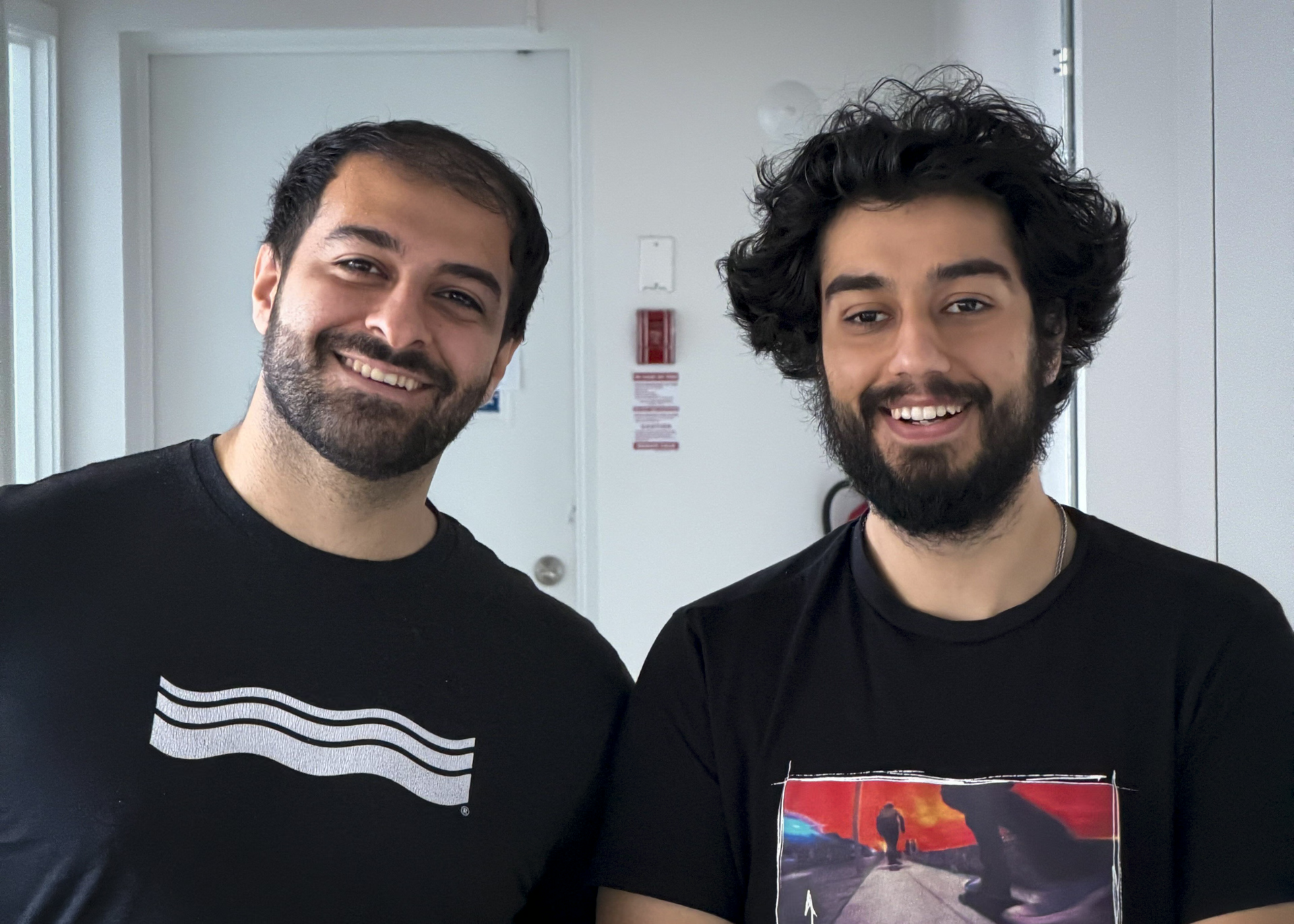
Hassan Ismail (BMath '24), co-founder of Argos Research alongside Hadi Alsibassi, has built the company around a simple diagnosis: deep learning, the paradigm behind nearly every AI system in use today, doesn't generalize. It memorizes.
Ismail has a simple analogy for the problem: today's AI is like a parrot. Show a deep learning model billions of hours of footage of someone riding a bike, and it can eventually mimic the motion. But it hasn't learned to ride the way a person does, in half an hour, by grasping concepts like balance and speed. It has memorized an enormous amount of what it's already seen. Researchers have shown that adding invisible noise to a photo of a panda, imperceptible to a person, can make an image-recognition AI confidently call it a monkey. The system was never reasoning about pandas. It was pattern-matching pixels.
“AI today is a lot like a parrot,” Ismail says. “It repeats what it's seen, and the real world is too dynamic for that to be enough.”
Argos is built on a different premise, drawn from the neuro-symbolic tradition rather than pure deep learning. Instead of statistically interpolating between examples it has already seen, the system reasons with a set of concepts and iterates on them as new situations arise, closer to how a person adapts a mental model on the fly than how a neural network curve-fits a dataset. Because the resulting programs can be read rather than treated as a black box, Ismail argues the approach is more transparent and potentially safer.
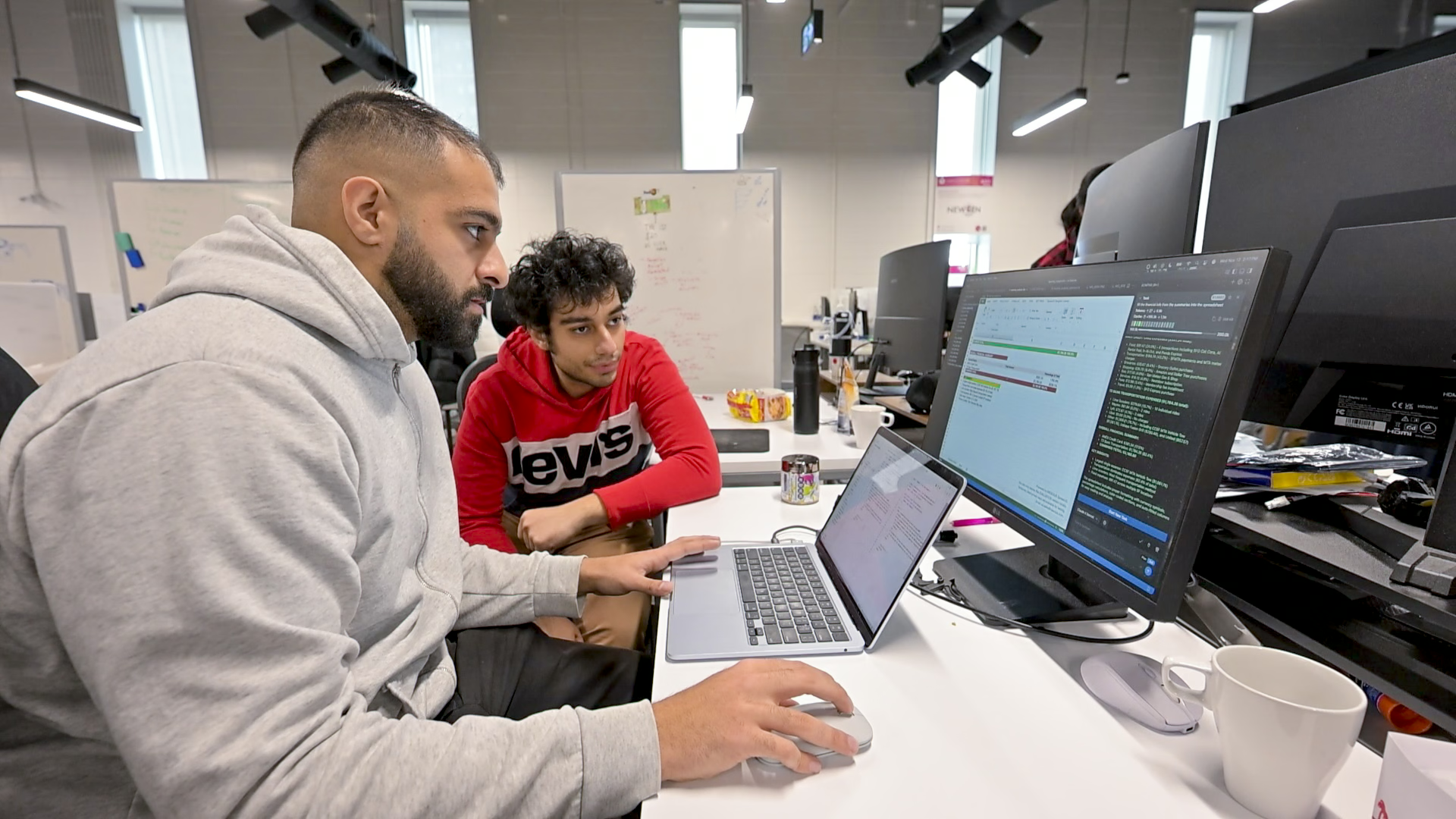
“Because we evolve programs that control these machines, you can read the code and know exactly what it's going to do.” he says.
Ismail and Alsibassi chose off-road autonomy, including self-driving and autonomous naval and land vehicles, as Argos's first proving ground, deliberately picking a domain where no two scenarios repeat and where deep learning's habit of memorizing terrain breaks down fastest. The opportunity extends well beyond research. Construction, mining, logging and defence logistics are all massive industries where autonomous vehicles could have a significant impact, making Argos's work a tangible test of whether its approach can hold up in the physical world.
The Waterloo ecosystem also gave the founders access to faculty and researchers across math, physics, and computer science, while Velocity helped connect them with industry partners.
To close that gap, the founders built a team of physicists, mathematicians, and statisticians alongside engineers, drawing on the abstract, conceptual thinking native to those fields rather than simply adding more engineering horsepower. Their goal is to build machines that can learn the way people do: not by remembering more, but by understanding better.