The flagship program behind Canada’s #1 university for entrepreneurs.
Momentum is a publication from Velocity. Periodically, we provide insight into Velocity’s activities and offer inspiration through the stories of Velocity founders.

A message from Velocity leadership.
Across the country, building a strong and prosperous economy is a top priority and there is no shortage of ambition to scale in Canada. In this issue of Momentum, you will see how real economic growth happens when local talent creates bold solutions right here at home.
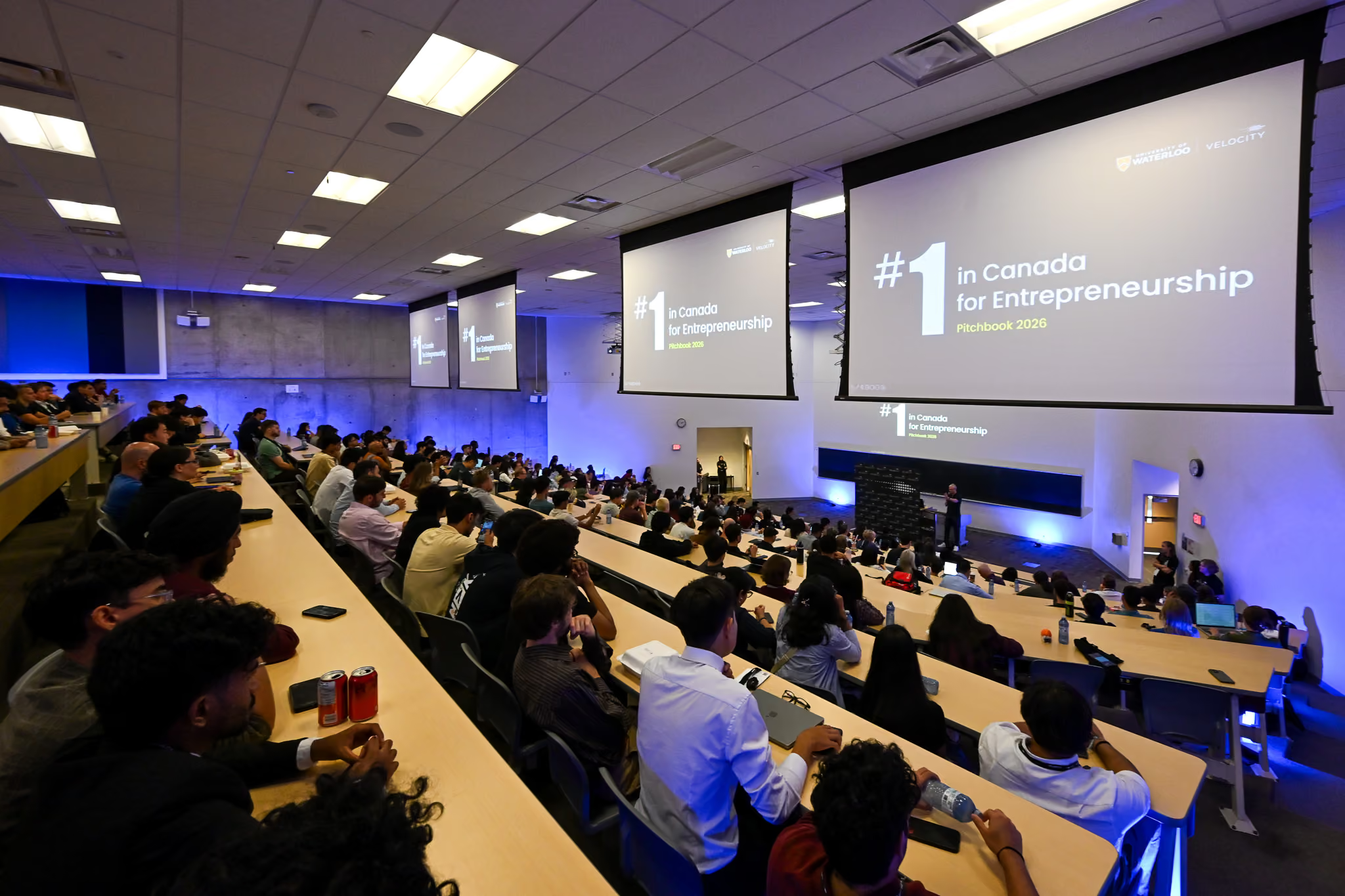
Velocity is the flagship program behind Canada’s #1 university for entrepreneurs, the University of Waterloo. Our founders are driving that success. By solving complex problems, building locally and scaling globally, founders are powering Canada’s global advantage across all sectors. From deep tech and artificial intelligence to health, cleantech, defence and advanced materials, Velocity founders are defining the future of Canadian enterprise and the Canadian economy.
Velocity is the flagship program behind Canada’s #1 university for entrepreneurs, the University of Waterloo. Our founders are driving that success. By solving complex problems, building locally and scaling globally, founders are powering Canada’s global advantage across all sectors. From deep tech and artificial intelligence to health, cleantech, defence and advanced materials, Velocity founders are defining the future of Canadian enterprise and the Canadian economy.
Today, Velocity companies are choosing to stay and grow in Canada. More than 80 per cent of Velocity businesses expand right here in Ontario. These entrepreneurs do more than start companies. They strengthen industries, create good-paying jobs and prove that world-class enterprises can thrive in Canada.
592
companies launched
11,000+
jobs created
Canada has the talent and foundation to compete on the global stage. Velocity founders are moving faster, building stronger, and scaling smarter. It is a privilege to support the founders who are ensuring our country’s future prosperity.
From an early idea on a whiteboard to a growing company signing customers and making sales, more founders are being trained than ever before.
Thank you to our entire community for supporting founders. Together, we are building a stronger economic future.
From an early idea on a whiteboard to a growing company signing customers and making sales, more founders are being trained than ever before.
Thank you to our entire community for supporting founders. Together, we are building a stronger economic future.

John Dick
Managing Director, Velocity
University of Waterloo
University of Waterloo
Messages of support.





Betting big on Canadian founders supported by Velocity
Every founder who walks through Velocity’s doors is betting on an idea, betting on themselves and betting on a future they can’t see yet. Velocity is here to back that bet.
This past year, more than 1,500 students and 96 full-time founders joined Velocity with ideas at every stage. Some arrived with early prototypes ready for validation, while others came prepared to secure their first customers or raise capital, and build a roadmap for growth. What they found reflects the foundation Velocity has built since 2008: equity-free funding to kickstart ventures, coaching from veteran entrepreneurs who have scaled companies themselves and a connected ecosystem of mentors, investors, and partners.
While Velocity continually evolves to meet modern market demands, its core mission to train and de-risk early-stage founders remains constant.
“In today’s climate of rapid technological shifts and unpredictable global dynamics, access to a dedicated network and community is more vital to startup success than ever,” says Krysta Traianovski (BSc ’15, MBET ’16), Associate Director of Founder Development at Velocity.
The community fuels founders from their very first steps on campus to their last. Key initiatives like the Velocity Summer Accelerator give new graduates a clear path forward. The three-month summer program moves the most promising students and new graduates to full-time commitment, helping them make the jump from the classroom to entrepreneurship.
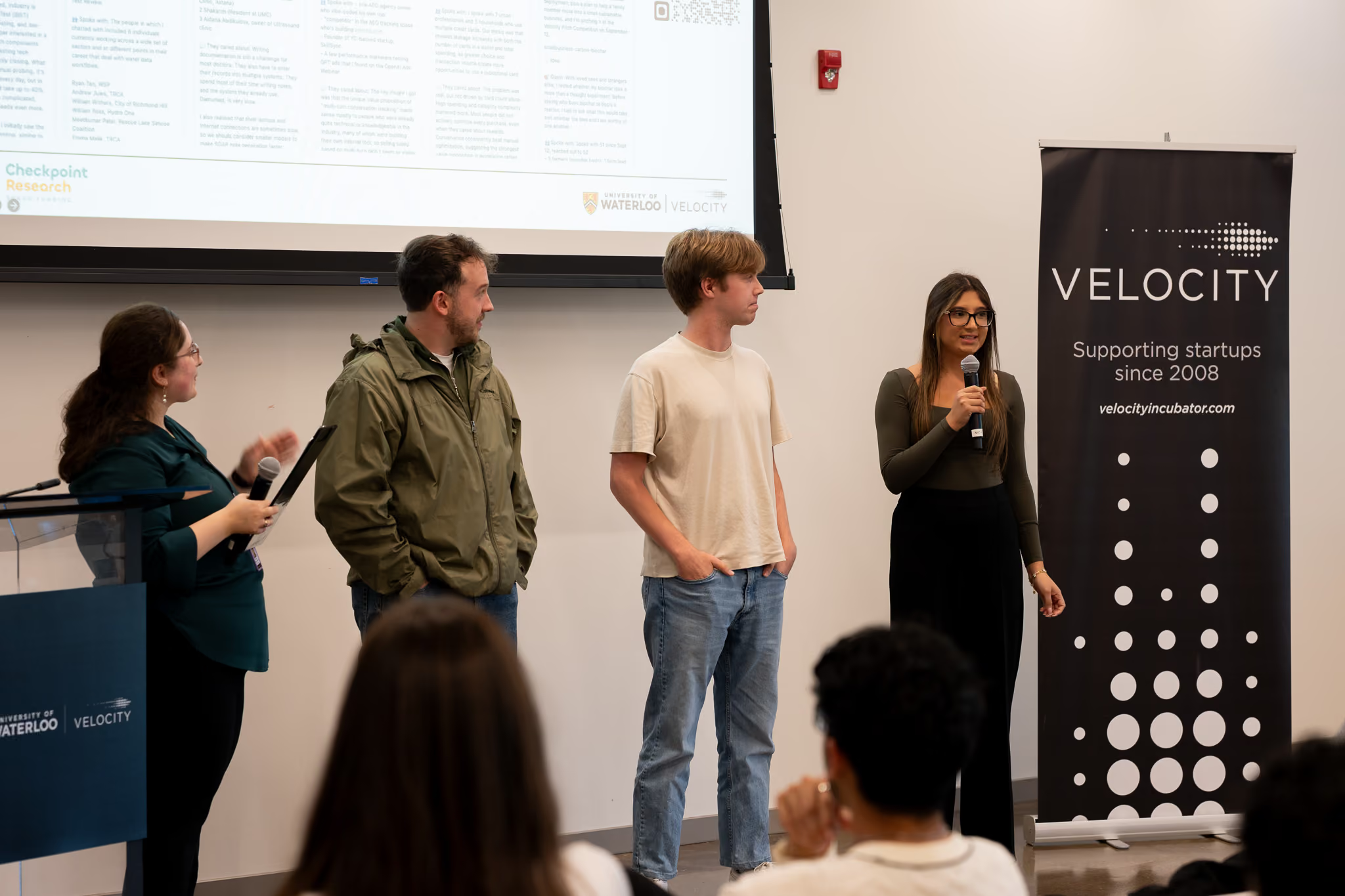
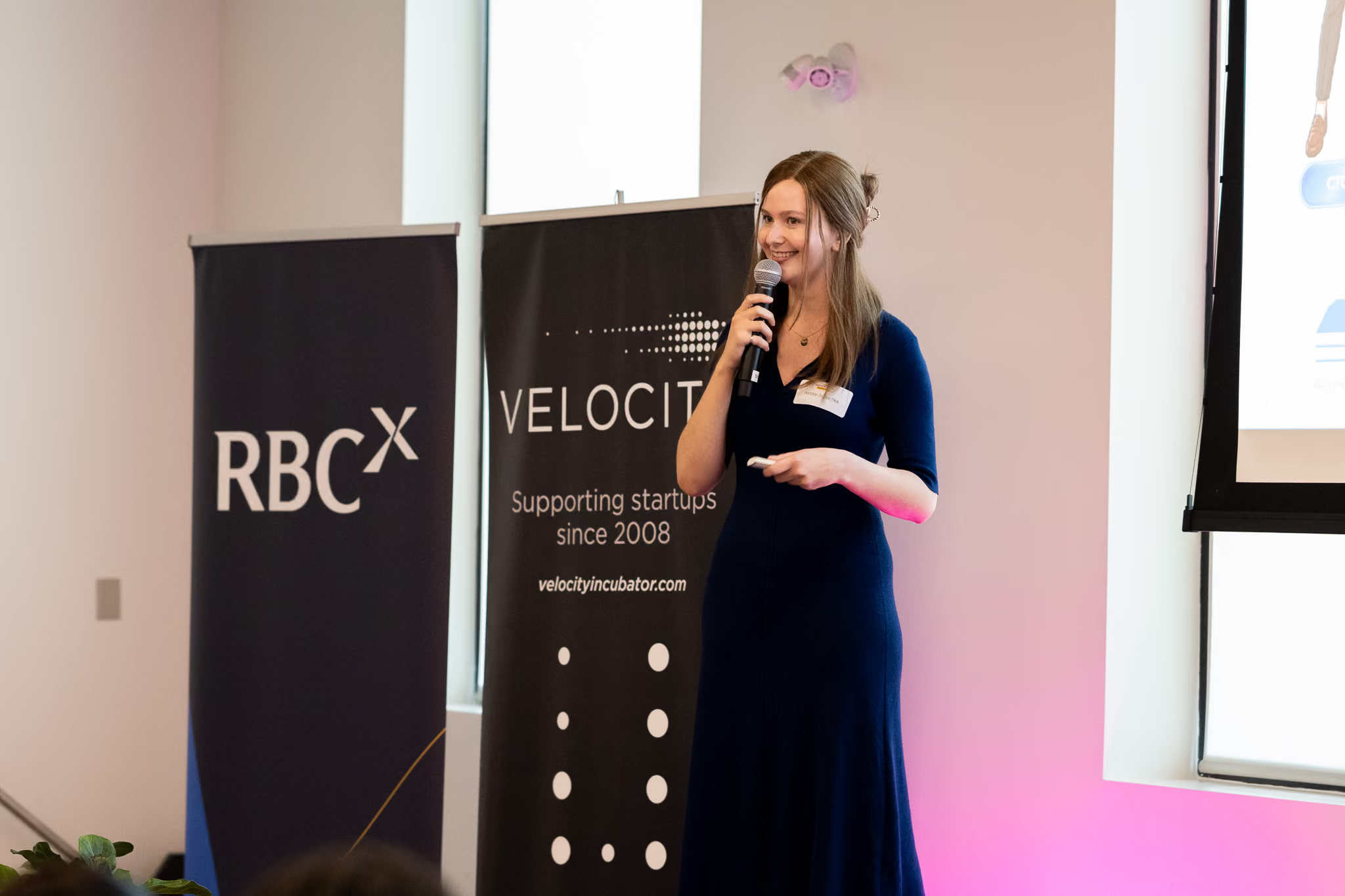
AllioHealth founder Ashley Juraschka pitches at the Summer Accelerator Demo Day.
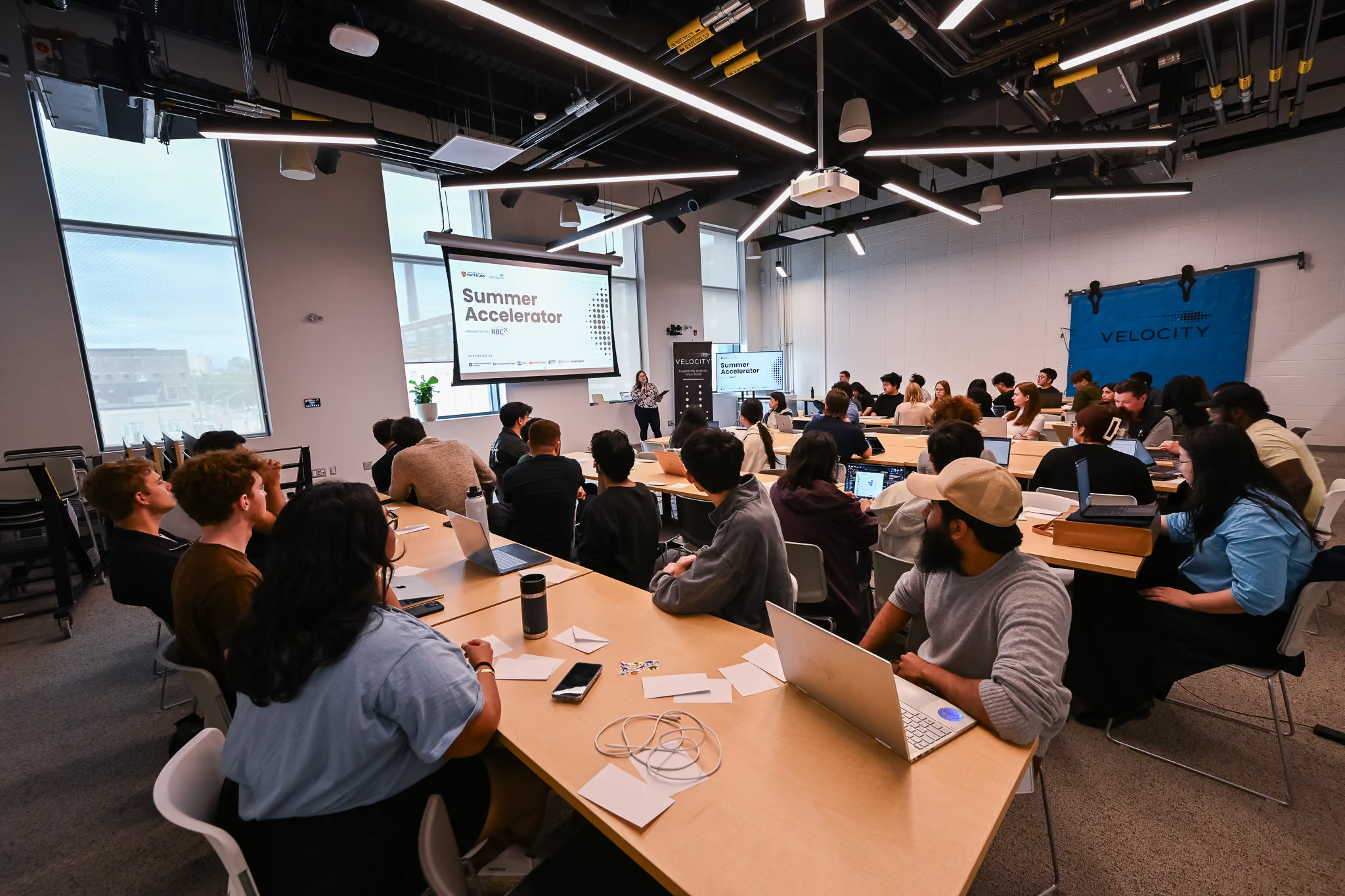
Summer Accelerator teams participate in a workshop.
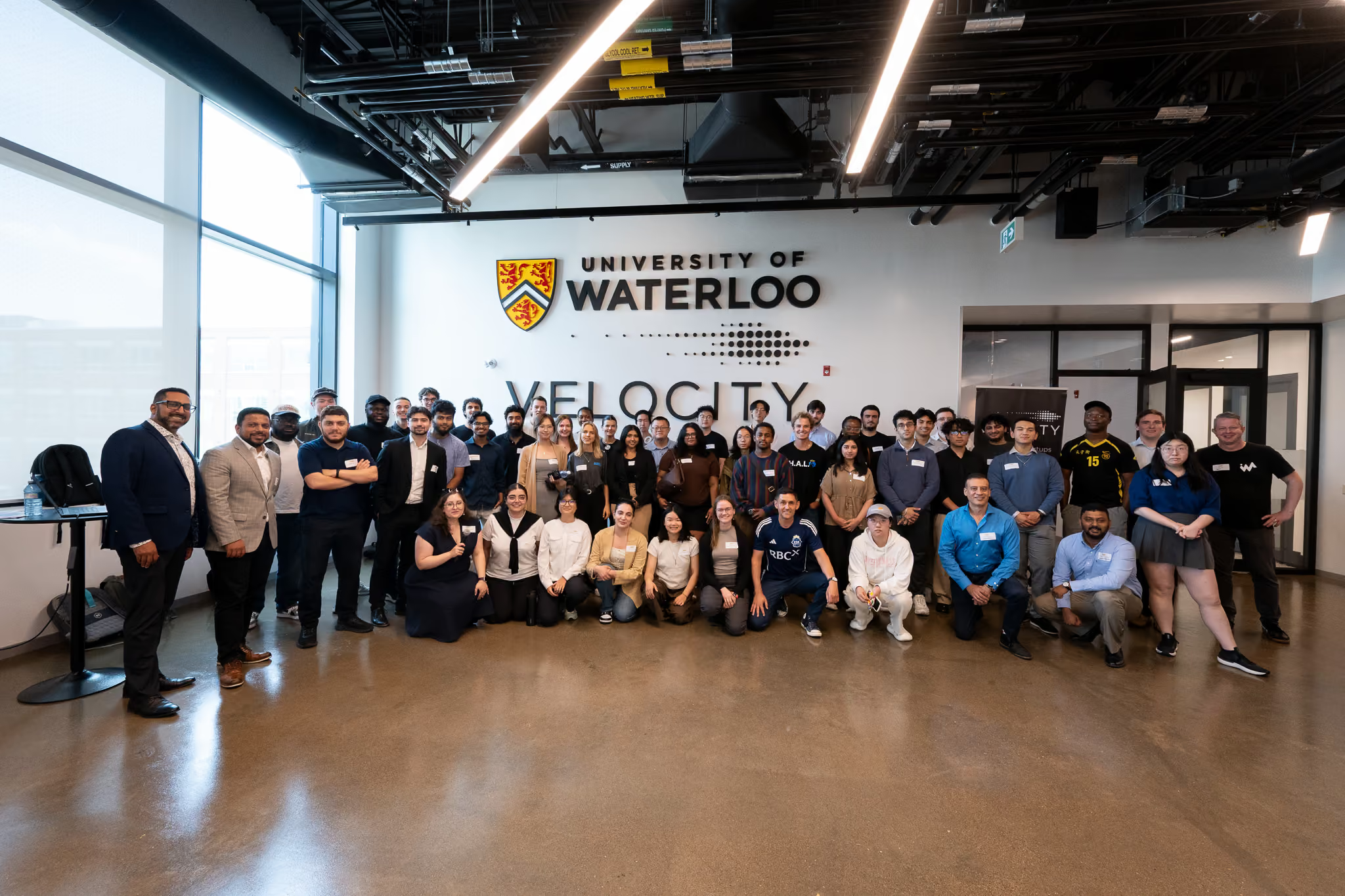
2026 Summer Accelerator teams.
In 2025, Velocity launched a successful pilot Summer Accelerator cohort of 18 teams stemming from student ideas, capstone projects and research. The program accelerates the transition from students to full-time founders. In 2026, with the generous support of the IPON (Intellectual Property Ontario) Innovation Fellowship Program, Velocity expanded the Summer Accelerator to 30 teams. Each received a $12,000 fellowship grant, dedicated co-working space, intellectual property education and weekly coaching to secure pilot projects and launch sales, culminating in a final demo day.
As these startups gain momentum, the opportunity to scale right here at home has never been stronger. Today, Canadian founders have a clear choice: rather than seeking growth elsewhere, entrepreneurs can tap into a booming local ecosystem with direct paths to global markets.
“Velocity startups are demonstrating that access to customers, capital, talent and networks required to compete globally exist right here,” says Andrew Martinko, Associate Director, Venture Creation and Growth at Velocity. Having joined Velocity in 2014, Martinko previously built and successfully exited SpotMyUV (Suncayr), a health-tech startup that developed smart, UV-sensing wearable patches to protect users from sun exposure.
With 55 new companies joining Velocity this past year out of over 450 incubator applications, there is no shortage of talent choosing to build at Canada’s premier startup incubator.
“By equipping ambitious founders with the resources to launch, grow, and lead, we enable the next generation of industry leaders to take root right where they are needed most,” Martinko says.
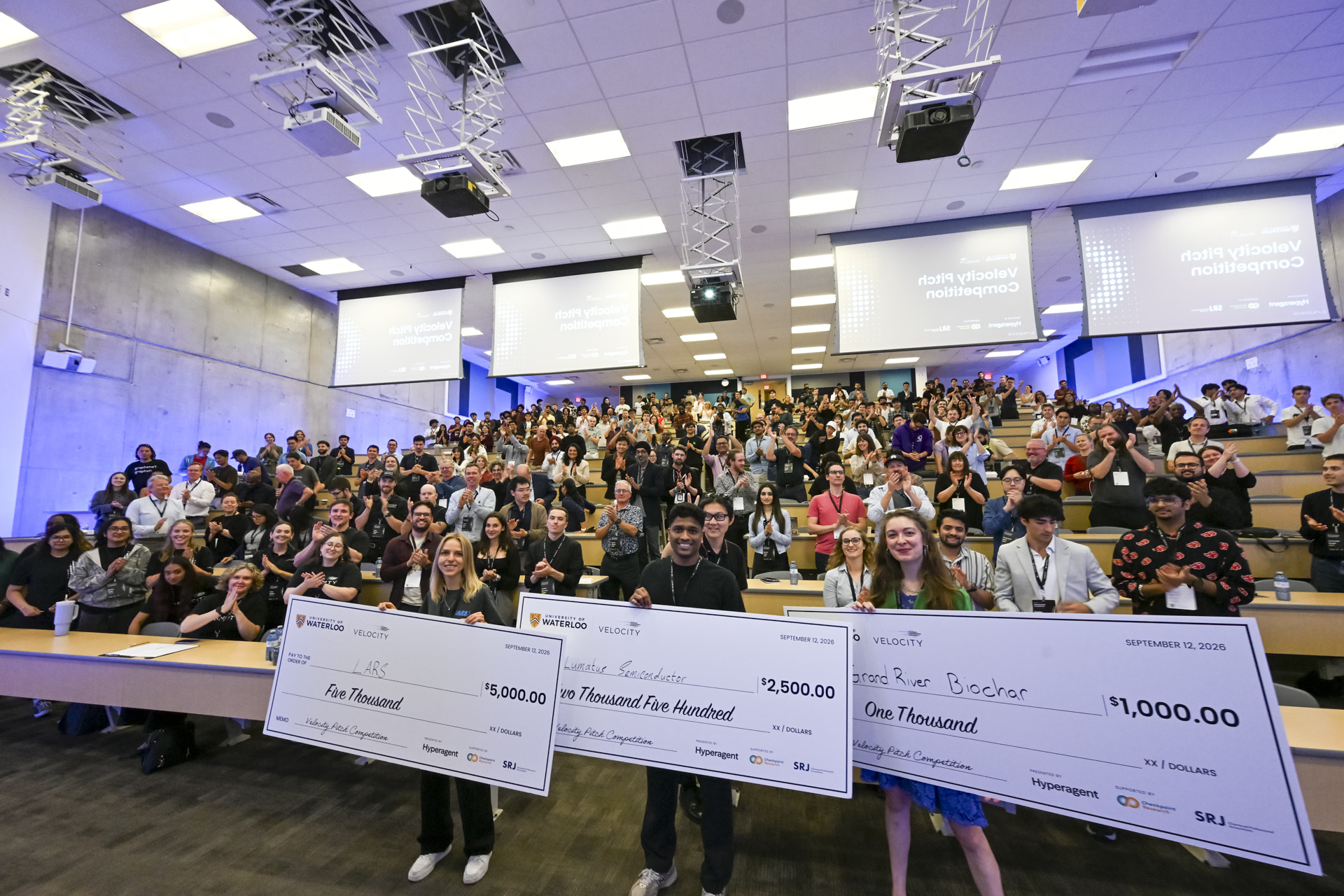
This past year, more than 1,500 students and 96 full-time founders joined Velocity with ideas at every stage.$4.34M
in all-time grants awarded
Awards granted to emerging student founders since 2021
$865,000
Through Up Start, Velocity engages with University of Waterloo research spinouts and has awarded $865,000.
$145,000
Velocity announced Momentum Grants in early 2025 to provide traction based non-dilutive funding to early-stage startups. The grants are made possible by generous donations to Velocity.
Learn more about how you can support Velocity’s new Momentum Grant program by giving.
Learn more about how you can support Velocity’s new Momentum Grant program by giving.
$25,000
annual Abundance Award
$360,000
in Summer Accelerator fellowships
Velocity Alumni scaling in Canada
We checked in with Velocity alumni who are scaling global companies from Canada. Here is what they’re saying.
Pablo Molina (BASc '11)
Co-Founder and CTO,
Avidbots (Velocity 2014)
Avidbots (Velocity 2014)

"When we first walked into Velocity, Avidbots was two co-founders and two robots in a box. Velocity gave us advice, room to build and believed in us when very few did. Since then, we’ve deployed more than 1,300 robots, shipped to over 20 countries, and still design and build them right here in Waterloo Region. We could have scaled anywhere, but we chose Canada because the engineering talent here is world-class and the community is strong. Avidbots is proof that Canadian-made robotics can compete on the global stage.”
Ryan Gallagher (BASc '21)
Co-Founder and CEO,
Scribenote Inc. (Velocity 2022)
Scribenote Inc. (Velocity 2022)

“I founded Scribenote out of Waterloo Nanotechnology Engineering. I consider myself a fortunate son of Canada. Canada has been a great place to grow up because past generations of talented people worked to make it so, and our generation has that same responsibility. That’s why it’s worth building awesome technology here. If no awesome technology gets built here, Canada’s fate is long-term economic decline. If it does, Canada will have a future worth smiling about! There are enough great companies around KW that I’m incredibly optimistic about the future, so much so that I’m betting my company on the hope that great building will continue to accelerate in Canada. Plus, our cold winters are a perfect breeding ground for cool side projects, and cool side projects are the raw ingredients for most world-changing companies. Nothing produces cooler side projects than cold air keeping us locked in. I attribute much of our current success with Scribenote to staying in Canada.”
Harleen Kaur
Co-Founder and CEO,
Ground News (Velocity 2015)
Ground News (Velocity 2015)

"We built Ground News in Waterloo on the belief that you don't have to leave Canada to build something the world uses. The talent here is exceptional, the ecosystem is generous, and there's a seriousness about solving hard problems that I haven't found anywhere else. Over seven years, Velocity gave us the room to turn an early idea into a profitable platform that millions of people trust to make sense of the news. Canadian-made technology isn't a constraint; it's a signal that something was built with care, for the long run."
Ruslan Nikolaev (BCS '20)
Co-Founder,
Float (Velocity 2019)
Float (Velocity 2019)

“I’m a Waterloo Computer Science grad, and like a lot of us, I was told the real opportunity was south of the border. I chose to build in Canada instead. Canadian businesses are the lifeblood of our economy, and for too long they’ve been stuck running on legacy financial tools that were never built for them. At Float, we’re showing you can build world-class technology here in Canada, for Canadian companies, and the talent coming out of Waterloo is a big part of why I have no doubt we’ll win.”
Youssef Helwa (BASc '15, MASc '18)
Co-Founder and CEO,
FluidAI (Velocity 2014)
FluidAI (Velocity 2014)

“FluidAI started in the Velocity Science program, and we raised our pre-seed while working out of the Velocity garage. We needed the ecosystem to make it happen. We're still in Kitchener today, growing from that seed with some of the best engineering talent in the world coming out of Waterloo, and it's a big part of why we've stayed. Our products today are used in the world's best hospitals, and the technology behind them was developed right here.”
Michael Litt (BASc '11)
Co-Founder and CEO,
Vidyard (Velocity 2012)
Vidyard (Velocity 2012)

"We built Vidyard in Waterloo because the talent here is world class and it sticks around. You get people who want to build something that lasts. Canada has everything you need to build a global company."
Why Waterloo students build companies before graduation
At the University of Waterloo, students aren’t waiting until graduation to start real businesses. They are diving in from their very first days on campus, turning fresh ideas into fast-growing ventures.
Velocity supports a continuous stream of student founders growing in both commitment and confidence. The community brings together curious thinkers and helps them develop into confident business leaders, and connects them with the resources they need to validate and scale.
The journey starts by opening doors to everyone. Cornerstone is a two-week customer discovery sprint running three times per year with no application forms, pitch decks or prior experience needed. By removing these traditional barriers, Cornerstone widens the funnel of talent by welcoming students who might never have pictured themselves as founders. The strategy is working: student participation has grown nearly ten-fold in four years, jumping from 46 teams in 2021 to 457 teams in 2025, with more than 60 percent advancing into deeper startup programs.
One founder who proves the power of this pathway is Tyler West (BASc ‘25), co-founder of Link Horizon. His company builds a drone-based land development platform that helps developers, engineers and contractors monitor their construction projects and optimize dirt movement on site. Instead of relying on manual site visits, Link Horizon flies drones over construction sites daily to collect visual and topographical data that is displayed within their software platform for any project stakeholder to view, measure and compare with design plans.
Tyler began his entrepreneurial journey on campus by participating in Cornerstone, followed by the two-week Future Cities Innovation Challenge. He went on to commercialize his capstone project, joined the first Summer Accelerator cohort, and ultimately joined the Velocity incubator.
“Starting on campus taught us the skills and importance of early customer discovery while the stakes were still low,” West says. “By the time we moved into full-time incubation at Velocity, we had built up the relationships, customer validation skills and confidence to secure funding and build out our product.”
To ensure more students follow that path, Velocity meets founders at every stage across campus. Hands-on entry points like AI-powered co-op simulations, Innovation Challenges, the Velocity Science Lab and even supporting academic programming like eight-month interdisciplinary Capstone projects and for credit business courses all helping students discover real-world problems. Velocity is also supporting research commercialization through the Up Start program to help turn intellectual property into commercial ventures.
As ideas take shape, Velocity provides open access to high-powered AI servers and specialized campus maker labs for software, hardware and lab-based development.
The pathway culminates at the Innovation Arena, Velocity’s 45,000-square-foot incubator. Packed with product development facilities including BSL-1, BSL-2, wet labs, assembly spaces and manufacturing facilities, it serves as the first official home for these promising early stage companies.

Tyler West (BASc ’25), co-founder of Link Horizon (left), speaks at Velocity’s Spring 2026 Future Cities Innovation Challenge.
Students reflecting on their experiences and sharing insights after completing Cornerstone.
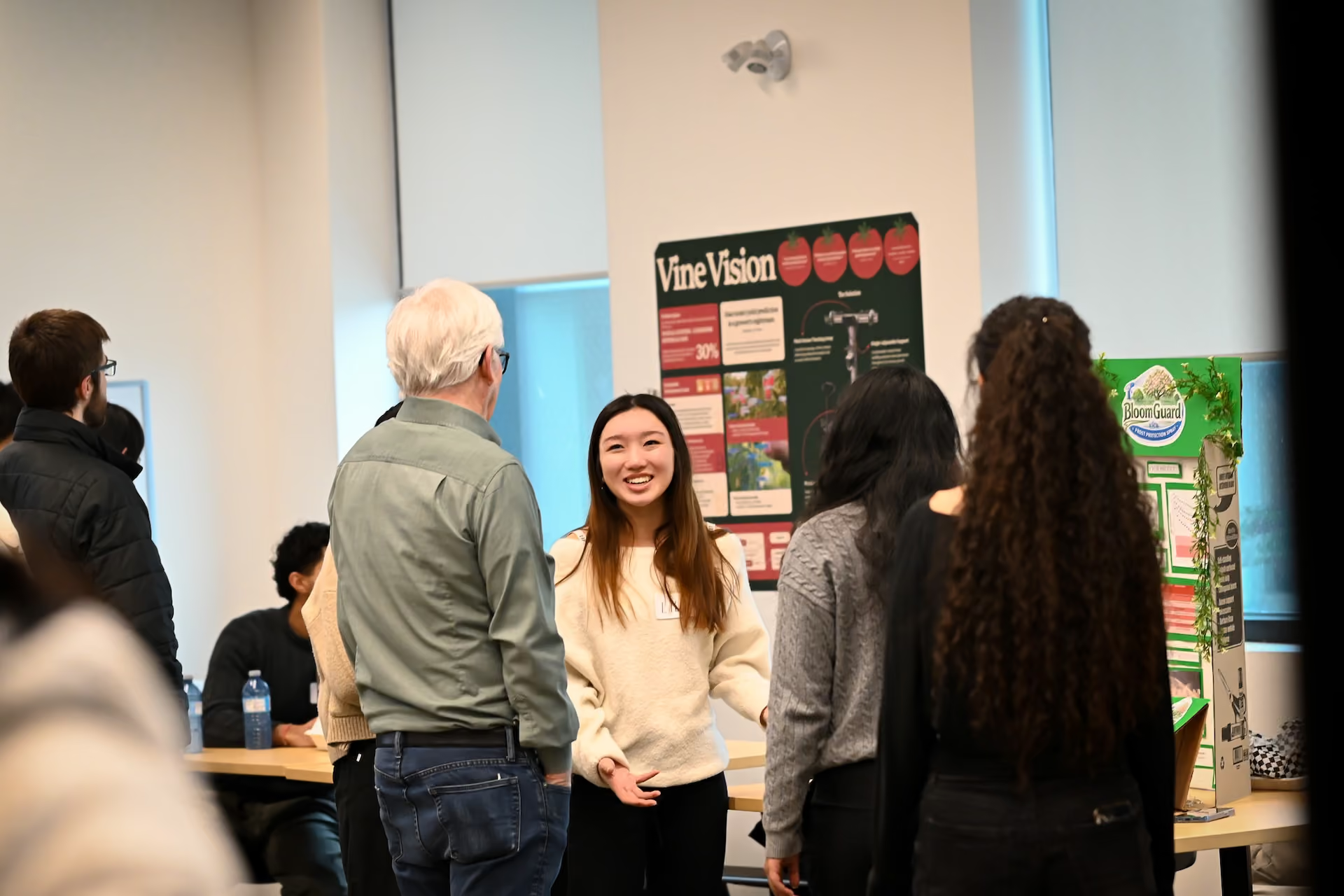
Students showcase their projects at the 2026 Agri-Food Innovation Challenge Showcase.
“Starting on campus taught us the skills and importance of early customer discovery while the stakes were still low" - Tyler West, co-founder of Link Horizon1,531
student entrepreneurs working with Velocity in 2025 and 5,560 student innovators since 2020
516
student-led teams at Velocity in 2025 and 1,416 student-led teams since 2020
Velocity wins top global honour for venture creation
The Global Consortium of Entrepreneurship Centers (GCEC) just announced its top honour for Outstanding Contributions to Venture Creation for 2026. The award, which acknowledges university centres creatively scaling startups based on program strength, growth, and tangible impact, went to Velocity. Earning this top honour puts Velocity in rare company alongside previous recipients like Harvard University, the University of Chicago, and New York University.
The win makes Velocity one of three Canadian university entrepreneurship centres in GCEC history to be recognized by the Global Consortium. “Velocity stands among the world’s leading university entrepreneurship centres. Beyond developing outstanding founders and helping them build ambitious companies, Velocity is shaping how entrepreneurship centres around the world train and support the next generation of entrepreneurs. We are proud to recognize that leadership with the Outstanding Contributions to Venture Creation Award,” said Holly DeArmond, Executive Director of GCEC.
The award capped off an incredible period of growth. In 2020, Velocity supported 30 teams building on campus. By 2025, that surged to more than 500 teams. That’s a 17-fold increase in the number of teams actively building and validating their business ideas with Velocity support.
That scale is directly tied to the University of Waterloo’s reputation as Canada’s top launchpad for entrepreneurs. In PitchBook’s 2026 University Rankings, Waterloo ranked 1st in Canada and 7th globally for producing venture-backed undergraduate entrepreneurs.
As the flagship incubator for the country’s top entrepreneurial university, Velocity has a deep understanding of what drives startup success and how to reduce risk. Rather than building in isolation, founders receive hands-on advisory, direct investor introductions and operational support to shorten the time to their first customers and capital.
“Waterloo was founded on a bold idea: that academic excellence, research, entrepreneurship, and real-world experience could come together to change lives and strengthen society,” said Dr. Bill Rosehart, President and Vice-Chancellor of the University of Waterloo. “That spirit of unconventional thinking remains our greatest strength, and this global recognition for Velocity demonstrates how our community continues to lead on the world stage.”
Real proof of this model is evident in the past year's success, with currently active founders working at Velocity’s incubator achieving $52 million in revenue. Beyond that early momentum, companies that move on to scale outside of Velocity are showing impressive impact.
Fintech leader Float raised $85 million in Series C funding, while business communications platform OpenPhone secured $105 million. In health and deep tech, FluidAI earned FDA clearance after supporting nearly 100,000 surgical procedures, and Alchemy Labs completed a $13.7 million IPO financing to list on the TSX Venture Exchange. Meanwhile, industrial robotics innovator Upside Robotics raised $7.5 million to scale sustainable farming technology. These are just a few notable moments from the last year among many.
By surrounding founders with structured validation, deep community support and tailored access to capital, Velocity has built a repeatable system for de-risking high-impact companies. GCEC’s recognition confirms what Waterloo founders prove every day: when you combine world-class talent with a model built for execution, the result is an engine for venture creation that leads globally.
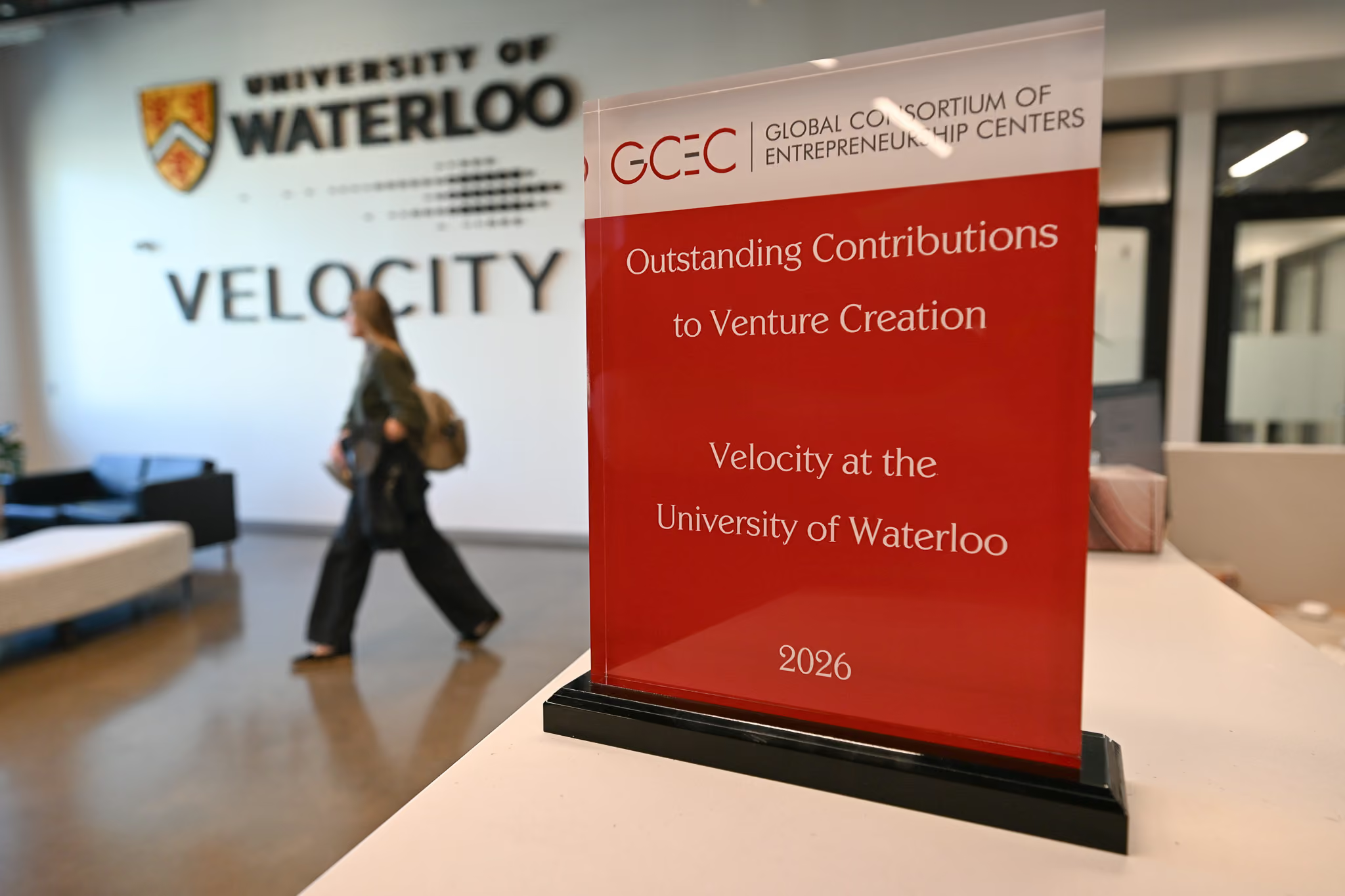
Velocity’s role in advancing university entrepreneurship earns an award from the Global Consortium of Entrepreneurship Centers.
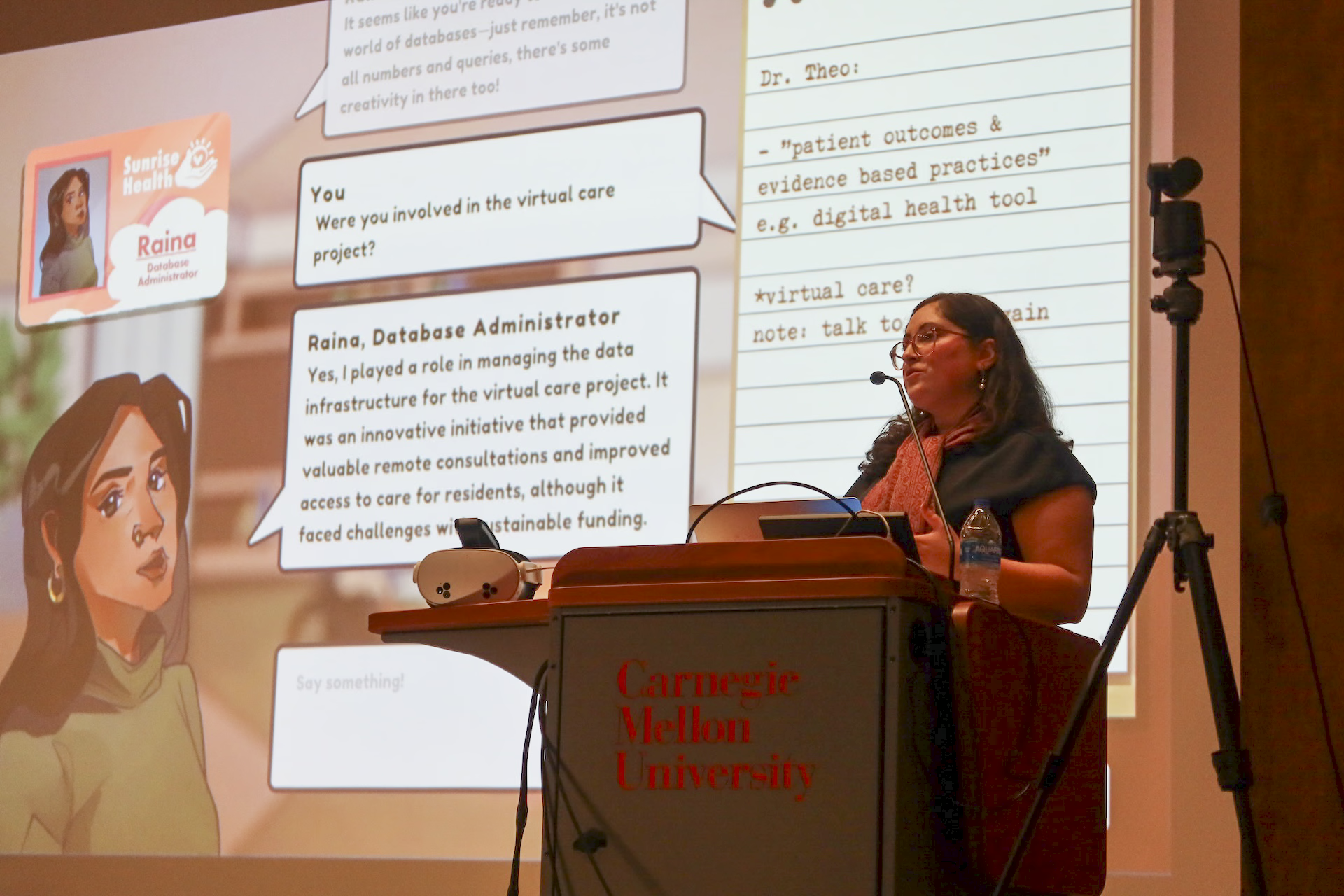
Presenting Velocity’s programs and initiatives at the 2026 GCEC Conference.
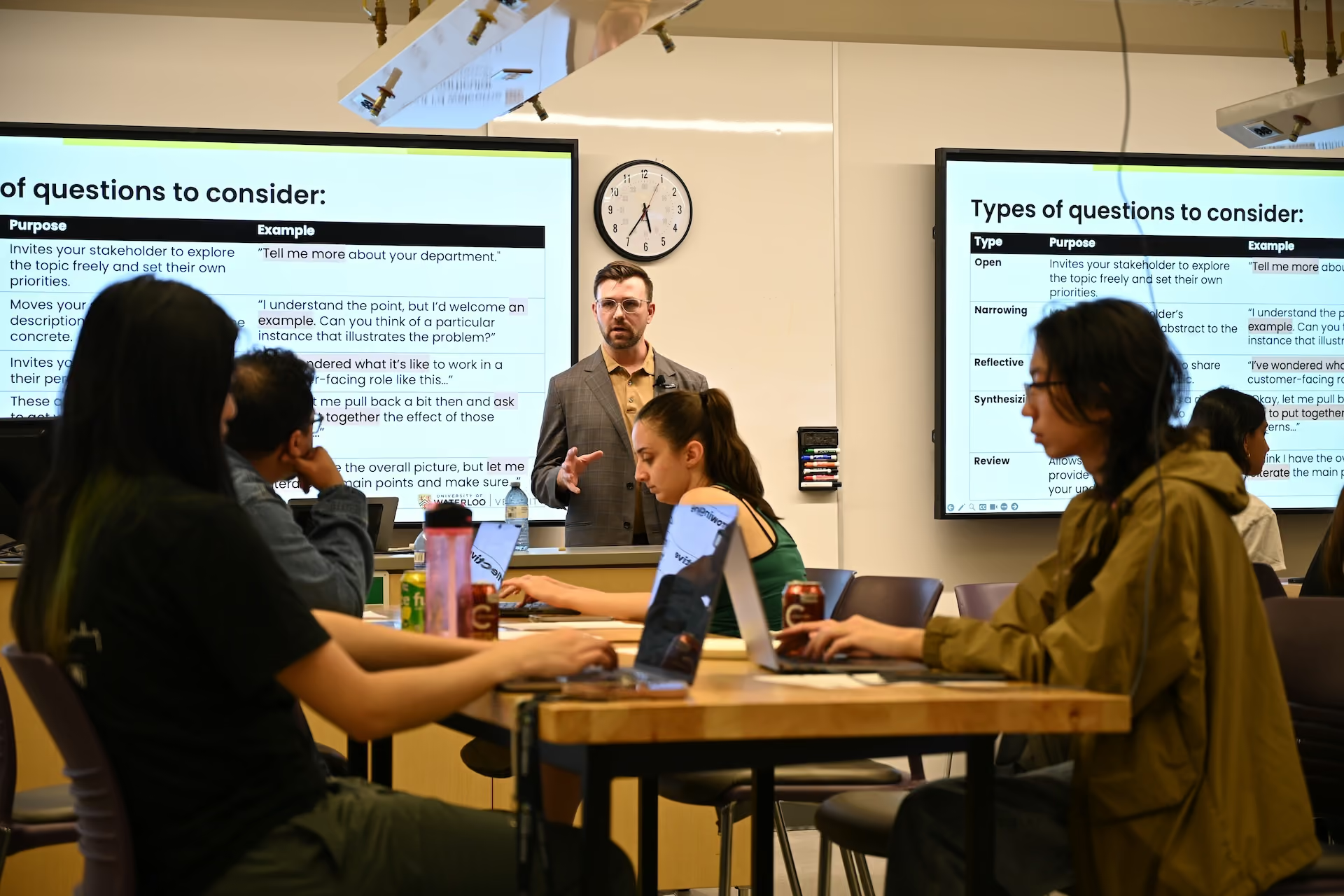
Students take part in Velocity’s campus programming at the University of Waterloo.
“Beyond developing outstanding founders and helping them build ambitious companies, Velocity is shaping how entrepreneurship centres around the world train and support the next generation of entrepreneurs." - Holly DeArmond, Executive Director of GCEC.From traction to $52 million in revenue
In the last year, 55 new companies joined Velocity at the Innovation Arena. Through Velocity’s active network, early-stage founders gained immediate access to more than 300 mentors and advisors, along with direct pathways to more than 100 investor connections.
“Our focus is entirely on driving measurable progress,” says Eric Pigden, Business Advisor at Velocity. “We work shoulder-to-shoulder with founders to refine their customer acquisition efforts, navigate sales friction and close deals. When you surround driven teams with real accountability and a tight-knit community, momentum follows fast.”
That dedicated focus translated into major results this past year. In 2025-26, active founders at Velocity’s incubator generated $52 million in revenue, secured $27 million in capital, launched 89 pilot projects and acquired 345 new customers.
By providing early-stage companies with high-touch advisory support, investor access and a collaborative environment, founders de-risk their path forward and build as market leaders right here in Canada.
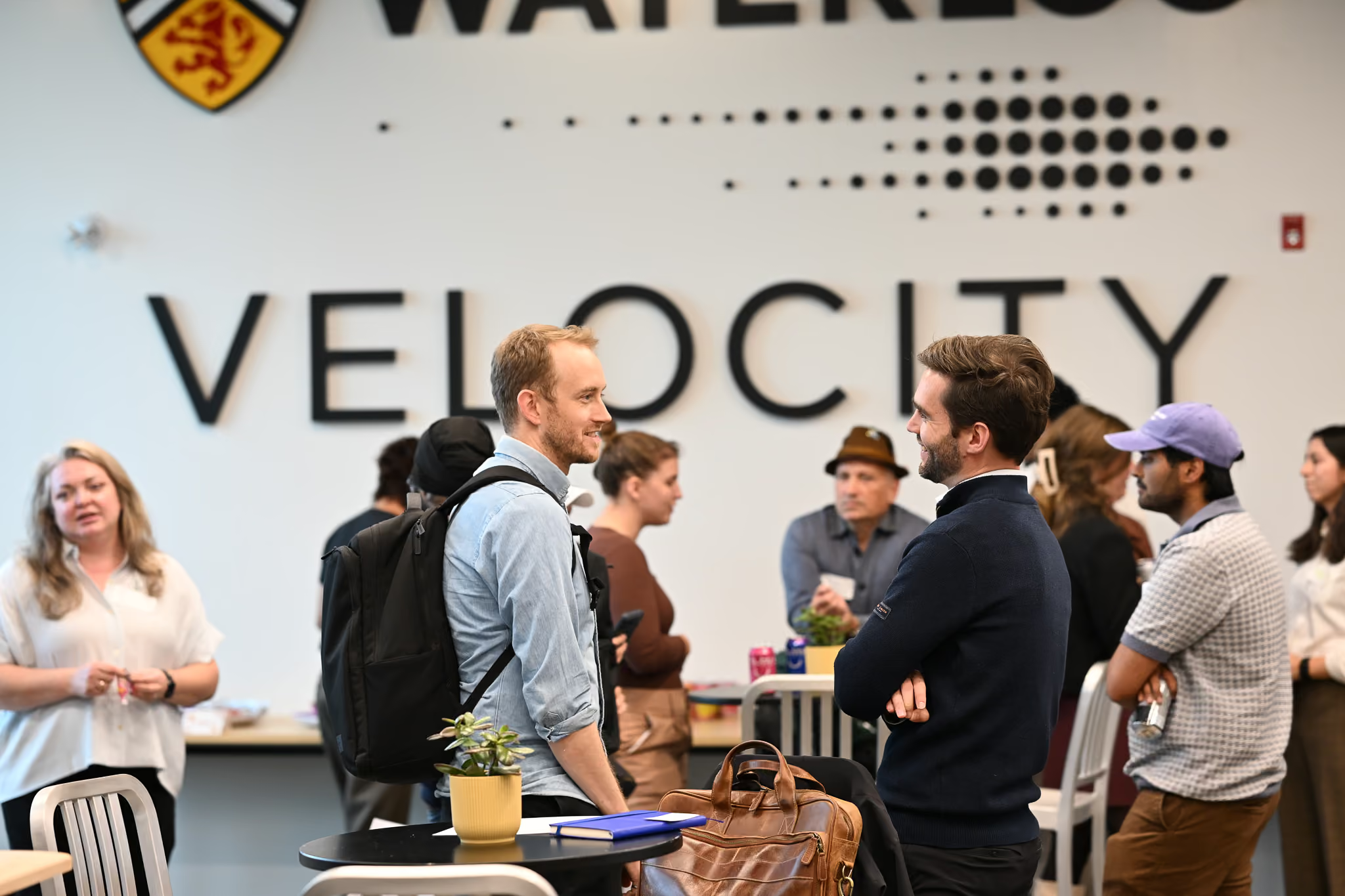
$52M
Revenue
$27M
Capital secured
89
Pilots unlocked
345
Customers acquired
Founders
to watch
We’re excited to share our second annual Founders to Watch list. It’s a curated look at the next wave of standout leaders and startups. Spanning AI, health tech and deep tech, these companies are moving fast, solving complex problems, and reshaping their industries. Selected for their early traction, founder resilience and long-term vision, these are the startups you’ll want on your radar.

Francois le Roux

Zaais van Zyl

The tech:
Archipelago Research focuses on how businesses and people use AI. Their first product is Evora, a platform that helps teams coordinate many models and agents in the most efficient way.
What Velocity advisors are saying:
The founders of Archipelago Research are customer-obsessed, exceptionally intelligent and fast-moving builders. They pair deep technical skill with a sharp focus on real user needs, turning advanced analytics into tools people can act on.

CT Murphy

Ibukun Elebute
The tech:
CELLECT Laboratories has developed a patent-pending, non-invasive specimen collection technology that transforms menstrual fluid into laboratory-ready samples for women's health research and disease screening. Its innovative platform captures cells, DNA, RNA, proteins, and other biomarkers, unlocking new possibilities for scientific discovery, biomarker research, and the detection of conditions such as cervical cancer, STIs, and endometriosis. Designed to integrate seamlessly into existing laboratory workflows, CELLECT is expanding access to a rich, historically underutilized source of biological information, accelerating women's health research while making screening more accessible, comfortable, and convenient.
What Velocity advisors are saying:
The founders of CELLECT are determined, mission-driven and unafraid of big challenges. They continue to push forward their vision of changing the Pap smear, building a better standard of gynecological care for all women.
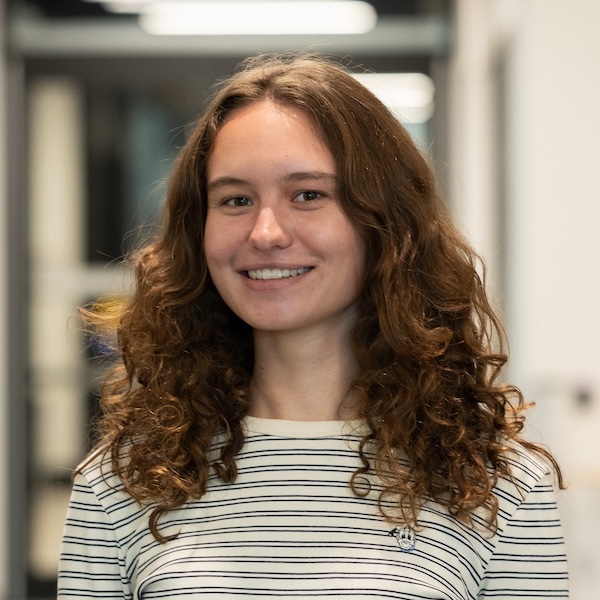
Liliana Hotsko

The tech:
Code2LoRA turns your codebase into large language model (LLM) knowledge. It learns your repository’s APIs, architecture, imports, conventions and development history, then compiles that knowledge into the LLM model itself. No massive prompts. No repeated repository context. Just an AI assistant that understands how your software actually works then compiles that knowledge into the local LLM weights.
What Velocity advisors are saying:
The founder of Code2LoRA is incredibly intelligent, highly technical and fluent in the language of her customers. She moves quickly and never hesitates to get in front of customers, turning those conversations into fast progress.

Ciara Azam
The tech:
The world's first all-in-one event management platform from contract signing to live maps to staff scheduling. Event planning is one of the top 5 most stressful jobs and Eventist aims to fix that.
What Velocity advisors are saying:
The founder of Eventist is bold, focused and undaunted by a giant competitor like Live Nation and Ticketmaster. She forged ahead to build a ticketing platform that both fans and organizers want to use, and we’re thrilled to see her technology deliver so much value.
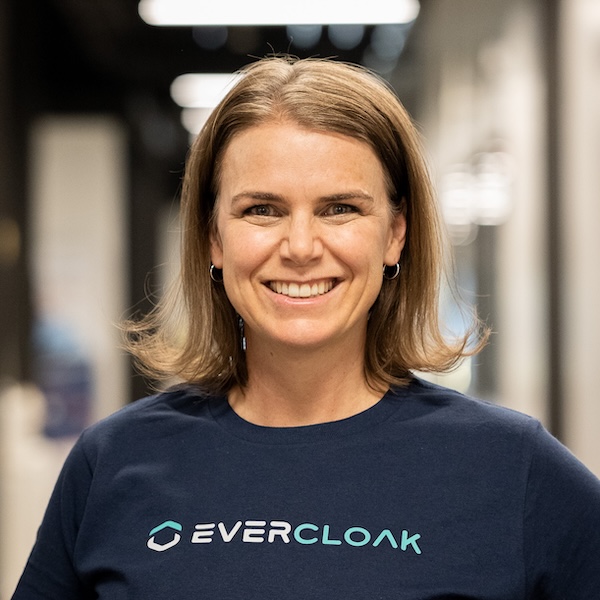
Evelyn Allen

Dr. Michael Pope
The tech:
Evercloak is developing proprietary membrane dehumidification technology designed to transform building cooling, slashing HVAC energy consumption and greenhouse gas emissions through scalable, refrigerant-free moisture removal.
What Velocity advisors are saying:
Evelyn and the Evercloak team are resilient, rigorous and consistently ahead of the challenges that come with building a deeptech startup. They have exceeded expectations again and again, and we’re excited to support them as they take their next step toward commercialization.

Paul Saucier
The tech:
EverKube is like ChatGPT for enterprise cybersecurity, powered by an organization-wide Security Graph that maps and understands the relationships across an organization's entire security environment. Through a simple chat interface, EverKube brings intelligence and context to existing security tools, helping teams identify risks, prioritize threats and make smarter, faster decisions.
What Velocity advisors are saying:
The founder of EverKube is a seasoned operator with deep industry expertise and a track record of building successful companies. He brings decades of hands-on experience and precise execution to building a platform that’s changing his industry.
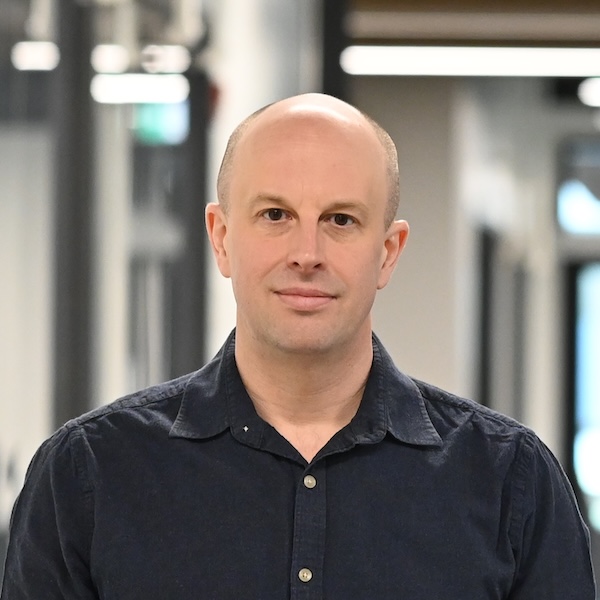
Adrien Côté
The tech:
Existent makes carbon capture simpler and more affordable. Using advanced, non-toxic molecular sponges called adsorbents, they reduce the complexity and cost of capturing carbon dioxide, helping industries meet climate goals and regulatory requirements. Their mission is to unlock economical carbon capture and fight climate change.
What Velocity advisors are saying:
The founder of Existent is a highly experienced operator-inventor who is structured, calculated and scientifically rigorous. With decades of materials scaling experience and research lineages tied to Nobel Prize-winning chemistry, Existent brings rare scientific depth to solving climate change.

Pasha Khoshkebari
The tech:
Hope is an AI tutor that helps students learn math in a more comprehensive, fun and personalized manner. Built on educational research and advanced AI, it acts like a personal teacher that adapts to each student's learning style to keep them motivated from grade one through grade 12.
What Velocity advisors are saying:
The founder of Hope is ambitious, exceptionally intelligent and deeply customer-obsessed. He works tirelessly to transform how students learn, combining cutting-edge technology with real empathy for the educational journey.

Jimmy Zhang

Larry Wu
The tech:
Kyumi is a collaborative workspace for hardware engineering teams that takes hardware from prototype to mass production faster. Instead of losing design decisions across emails, meetings and slides, Kyumi links every comment and revision directly to exact 3D geometry, parts, and manufacturing requirements. This gives AI models the full context of what’s being built. Engineers can quickly recall past decisions, align teams and catch costly errors early.
What Velocity advisors are saying:
The founders of Kyumi are hyper-focused, personable and deeply customer-obsessed. They bring high energy to solving real engineering headaches, moving quickly to deliver tools that hardware teams love.
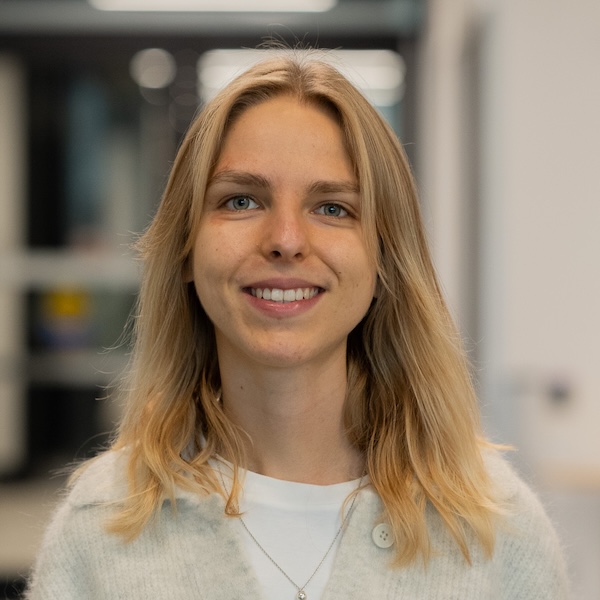
Serena Wittenberg

Rylin Soto

Angelica Wittenberg
The tech:
LARS Medical Inc. is developing robotic assistive technology that offloads the physical burden of ultrasound scanning without disrupting clinical workflow.
What Velocity advisors are saying:
The founders of LARS Medical are hardworking, creative and willing to push outside their comfort zone. They find inventive ways to overcome problems and keep a strong bias toward failing fast and learning from mistakes.

Pranav Gavirneni

Dr. William S. Wong

Dr. Manoj Sachdev
The tech:
Lumatus builds technology that helps surgeons tell cancerous tissue from healthy tissue during surgery so they don’t have to guess.
What Velocity advisors are saying:
The founders of Lumatus are incredibly intelligent, ambitious and meticulous problem-solvers. They bring the precision and focus needed to take on a life-changing medical challenge and transform cancer surgery.

Sanal Sina Kamal
The tech:
Photon-IV builds smart software that connects satellites in space with communications networks on the ground. By using AI to pass signals smoothly back and forth, it keeps defence, flight and emergency systems online without dropouts or delays.
What Velocity advisors are saying:
The founder of Photon-IV is surgical, methodical and deeply measured. With a highly strategic mindset for complex aerospace and defence challenges, Photon-IV is led by exactly the right founder for the job.

Miraal Kabir
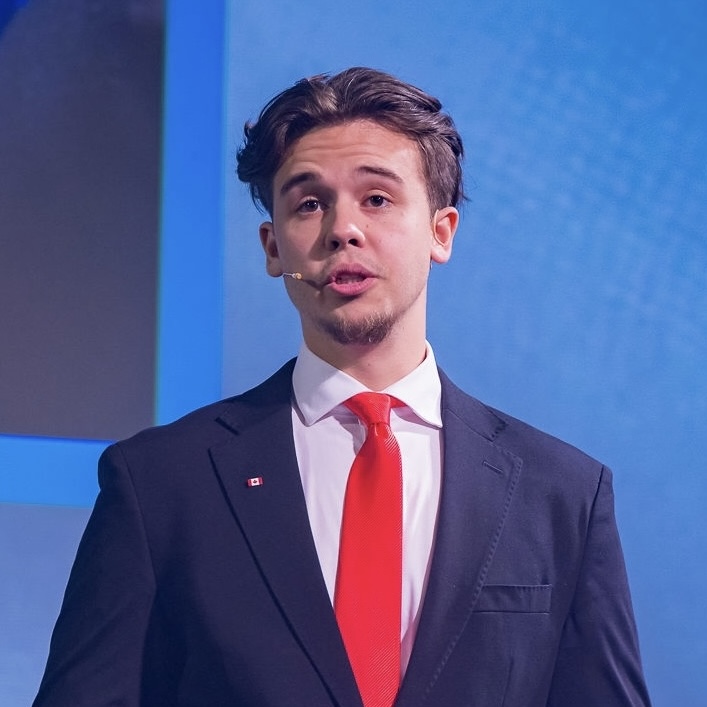
Martin Turuta
The tech:
Safi Data is an AI-powered data collection platform that captures multimodal data from African communities at scale through WhatsApp and SMS. We turn this into affordable, high-volume insights for market research and due diligence, as well as localized datasets and specialized speech models that perform better in African markets.
What Velocity advisors are saying:
The founders of Safi are curious, grounded and deeply connected to the markets they serve. They immerse themselves in a market, listen closely to its problems and build solutions around them, and it’s been a pleasure watching them grow and deliver real impact for customers across Africa.
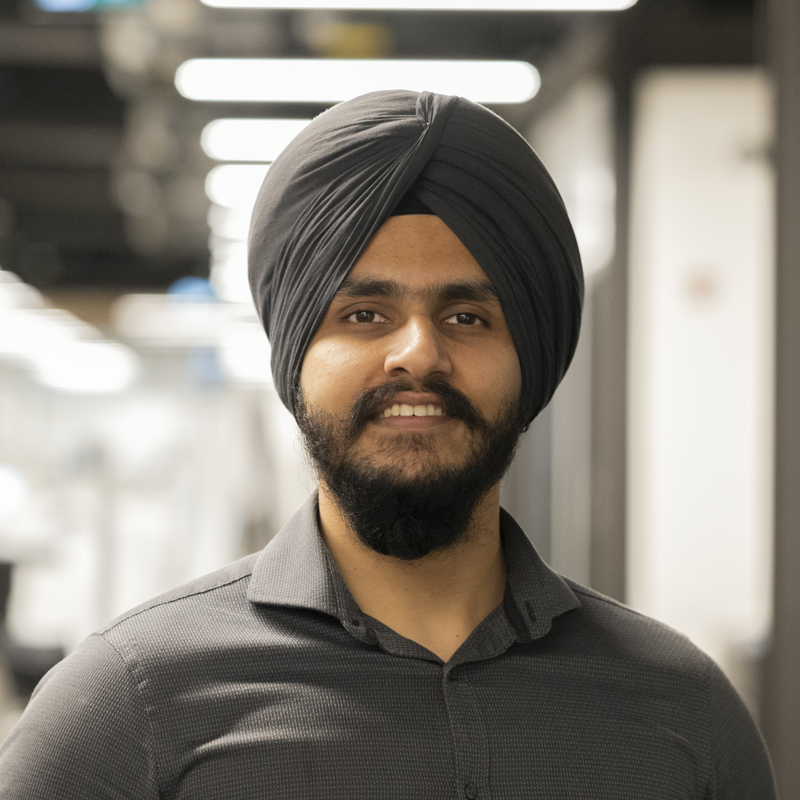
Mankirat Singh Sains

James Hinsperger
The tech:
Sidian is building a smart workspace for structural engineers that connects all their separate tools and software. It acts like a digital memory, helping teams instantly find past design work, follow company standards, and automate tedious, repetitive tasks.
What Velocity advisors are saying:
The founders of Sidian are ambitious, hardworking and deeply customer-centric. Having lived this exact problem first-hand, they bring relentless energy and focus to building the tools structural engineers actually need.
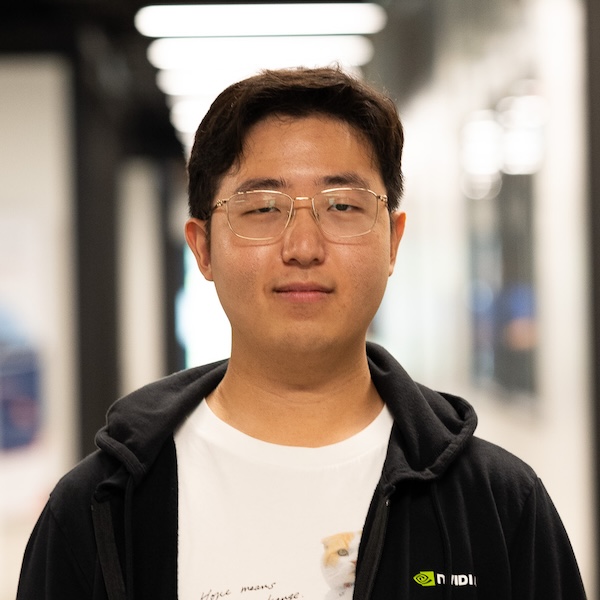
Seungmin Hong

Ahnaf Shahriar
The tech:
Simantic is an advanced simulation platform that allows engineers and AI systems to build, test and validate firmware in virtual environments long before physical hardware is manufactured.
What Velocity advisors are saying:
The founders of Simantic are relentless problem-solvers and remarkably resourceful builders. Moving at incredible speed from idea to execution, they are tackling a critical hardware bottleneck with the drive, focus and technical agility needed to reshape how embedded systems are tested.
Global leaders: Canada’s #1 innovation engine
PitchBook’s 2026 University Rankings place the University of Waterloo 7th globally for producing venturebacked entrepreneurs. This is the first time a Canadian institution has broken into the global top 10, and the highest ranking for any university outside the U.S.
#1 in Canada and #7 in the world
Waterloo ranked 1st in Canada and 7th globally for undergraduate entrepreneurs. (PitchBook 2026)
#11 globally for female founders
Recognized as the fastest-rising university globally for venture-backed female founders. (PitchBook 2026)

Building big at home: Velocity founders scaling global enterprises in Canada
Graduates from the University of Waterloo have built thousands of businesses worth hundreds of billions of dollars. According to the University’s 2026 economic impact report, Waterloo alumni have launched more than 67,900 companies worldwide, generating $397 billion every year. In Ontario alone, these entrepreneurs have contributed $405 million to the economy.
At the forefront are startups with roots at Velocity, which account for more than $40 billion of that global total. From Velocity to global markets, Velocity founders are proving that world-class tech leaders can start and stay in Canada.
Take Faire, for example. Co-founded by Marcelo Cortes, who studied at Waterloo, the multibillion-dollar shopping platform incubated at Velocity and has raised $2.14 billion. Another success story is Trusscore, a building materials company that started at Velocity in 2020. Today, it is headquartered in downtown Kitchener in the very same space that once housed the incubator.
That entrepreneurial momentum is accelerating across every stage of growth. Mappedin founder Hongwei Liu started the indoor mapping company while studying at Waterloo; today, Mappedin is expanding its footprint worldwide after securing $24.5 million in growth capital.
As these businesses grow, they are staying right here in Canada. Fast-growing financial platform Float, co-founded by Waterloo alum Ruslan Nikolaev (BCS ’20) and Griffin Keglevich, who started the company while studying at Waterloo, raised $85 million to expand its suite of business tools for companies across the country.
“Canadian businesses are asking harder questions about who they trust with their finances, and they want answers built here, for them,” says Rob Khazzam, Co-Founder and CEO of Float. “This is the moment we built Float for.”
Waterloo founders are also demonstrating the path to the public stock market. Co-founded by Waterloo engineering graduate Khanjan Desai (BASc ’13), nanotechnology pioneer Alchemy Labs completed its $13.7 million IPO financing. Now listed on the TSX Venture Exchange, the company is scaling its defence and automotive protective solutions.
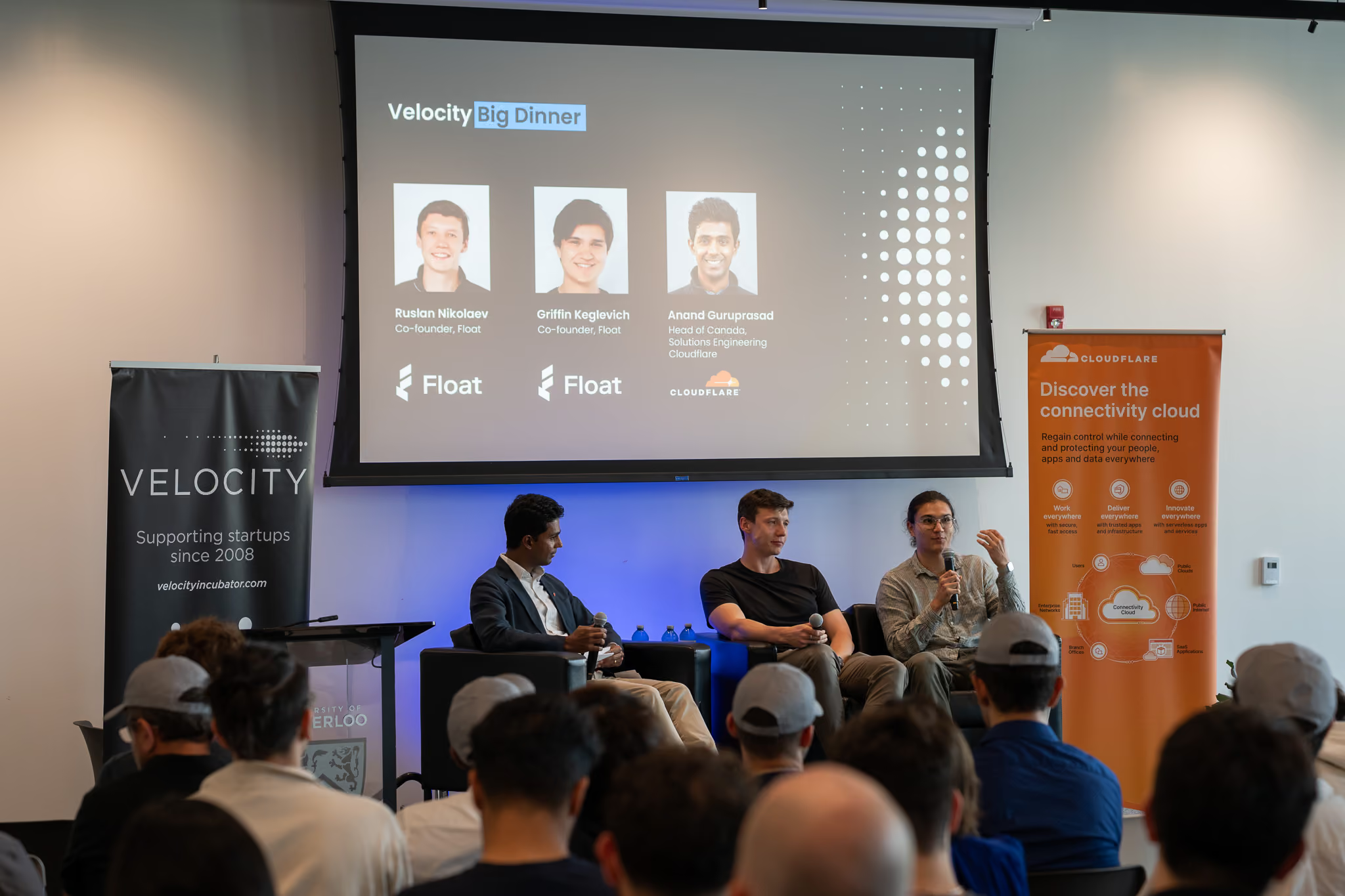
Float co-founders Ruslan Nikolaev (centre) and Griffin Keglevich (right) speak at the Velocity Big Dinner.
Fast-growing financial platform Float, co-founded by Waterloo alum Ruslan Nikolaev (BCS ’20) and Griffin Keglevich, who started the company while studying at Waterloo, raised $85 million to expand its suite of business tools for companies across the country.
Scaling health tech in Canada: The Velocity health initiative
As Velocity founders build global enterprises across every sector, health-care innovation has rapidly emerged as a standout pillar of the ecosystem. Over three years, companies supported by Velocity health have already benefited more than 300,000 patients worldwide.
In 2023, Velocity health was launched as a dedicated initiative designed to supercharge how digital health and medical technologies move from concept to bedside. It was built to help founders with rapid validation in real clinical settings and attract the capital needed to grow.
Beyond helping patients, Velocity health founders are driving economic growth. Through the initiative, 162 companies have created 1,236 new jobs, brought in more than $400 million in revenue and secured $250 million in foreign direct investment. With 322 new medical products launched and 564 intellectual property assets secured, they are proving local health innovations can scale globally while building strength right here at home.
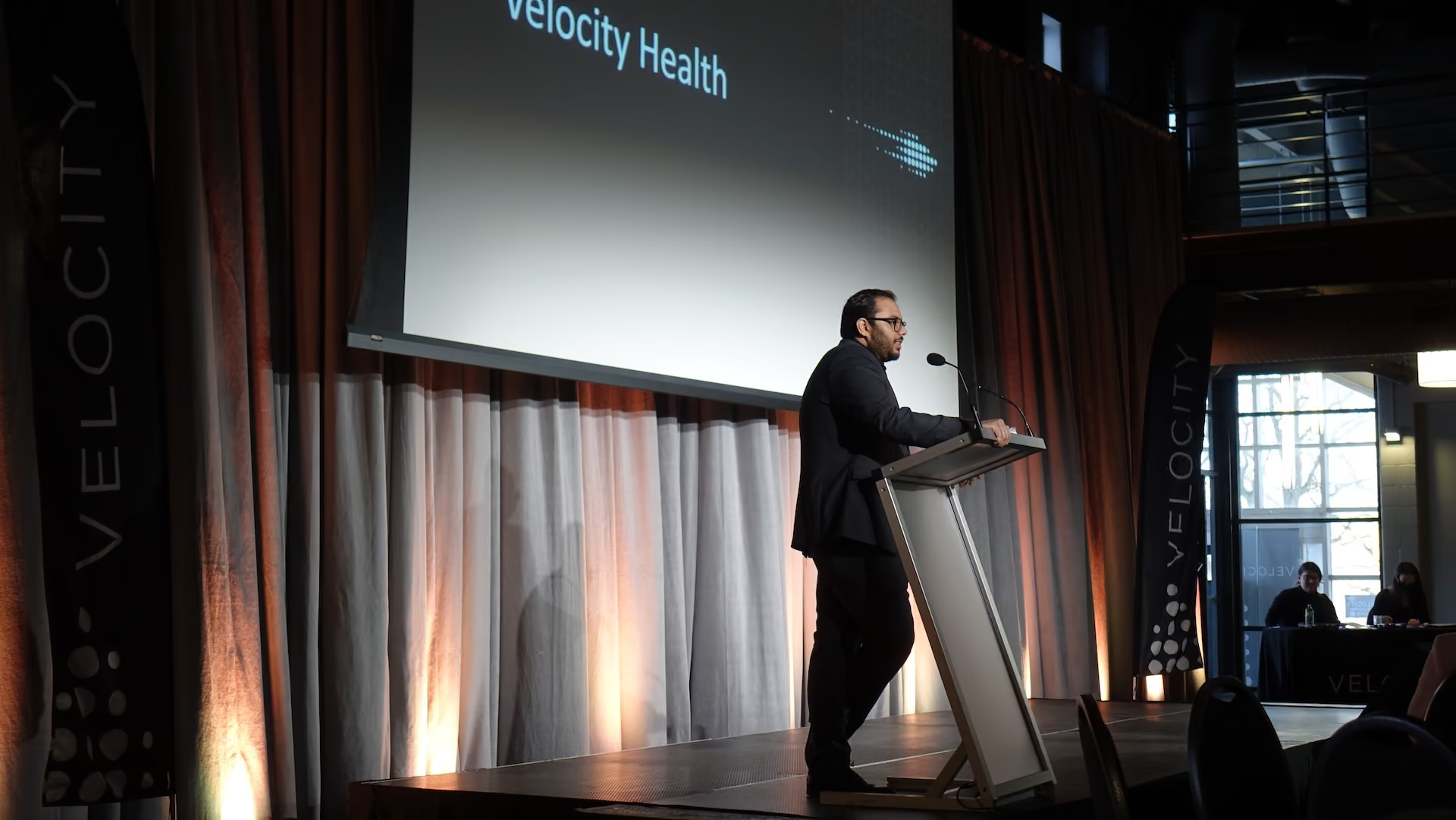
Moazam Khan, former managing director of Venture Scale and Health at Velocity, speaks at Velocity’s launch event in March 2023.

FluidAI co-founder Youssef Helwa speaks at Digital Health 2025, hosted at the University of Waterloo.
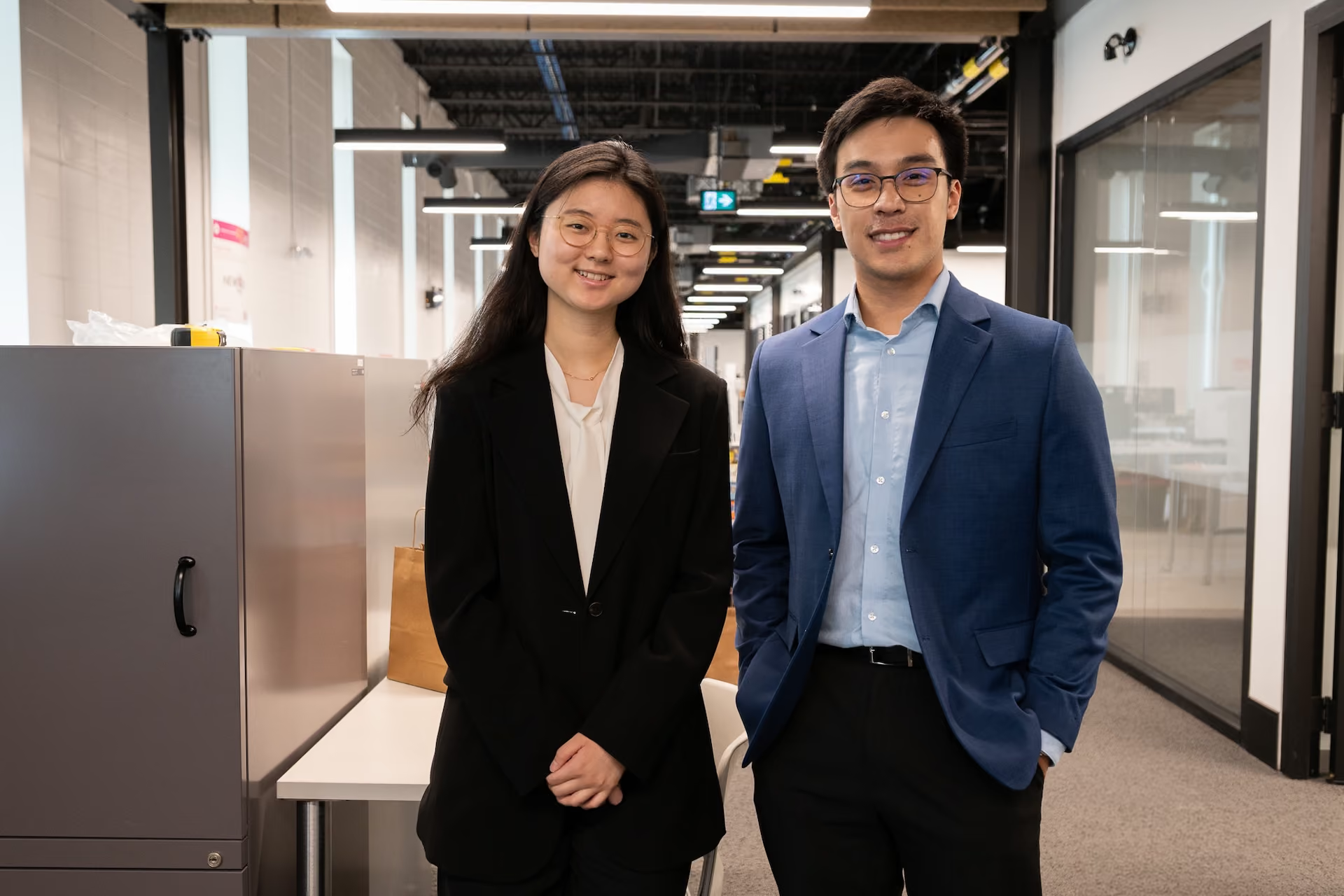
Patient Companion co-founders Christy Lee (BASc ’24) and Ethan Alvizo (BASc ’24), pictured left to right
The initiative was established under the leadership of Moazam Khan (BSc ’16, MBET ’17), former Managing Director of Venture Scale and Health at Velocity, and current Senior Director of New Ventures at Redesign Health—a global venture and applied AI firm focused on building next-generation health-care companies. Built on a founder-first philosophy, Velocity health’s operating model was designed to create a robust, interconnected innovation ecosystem that systematically de-risked earlystage technologies. By providing founders with access to real-world validation environments, strategic partnerships, industry expertise, and commercialization resources, it sought to accelerate the translation of promising innovations into scalable ventures. In doing so, it unlocks direct pathways to critical capital, customers and market opportunities.
Velocity health, funded in part by the Government of Canada through the Federal Economic Development Agency for Southern Ontario (FedDev Ontario) united a powerful coalition of regional and national partners. This coalition includes the Accelerating Clinical Trials Consortium at McMaster University, the IMPACT program at the University of Calgary, the Medical Innovation Xchange, Western University, and more than 40 health-care providers across Ontario. These partners provide both valuable guidance and commitments to early stage pilots, which is critical for early stage de-risking for health founders.
“One of the biggest challenges in health-care innovation isn’t just building the technology,” explains Christy Lee (BASc ’24), Co-Founder of PatientCompanion, a digital platform that streamlines communication between patients and care teams.
“It’s getting it into real clinical settings where you can learn what actually works. Velocity health helped us bridge that gap through mentorship, connections to the health-care ecosystem, and opportunities to validate our assumptions early. That support has been incredibly valuable as we’ve grown PatientCompanion from an idea into a solution being used in hospitals across Ontario.”
This support reduces the time and friction founders and innovators face when validating their technologies. It also provides founders with the direct opportunity to pivot toward market demand based on feedback from potential customers.
Connor Kapahi (PhD ‘26) has been a founder with Velocity health since day one of building his company, Mandel Diagnostics, an automated screening device that detects age-related macular degeneration. He knows that building a medtech company means working within the restrictions created by regulators, who are good at explaining what you cannot do, but rarely share what you should do. He says Velocity health solved that problem.
“Moazam and the Velocity health team took the mystery out of the regulatory process and helped us build a strategy to prove customer demand even as we sought regulatory approval. Those plans took us through customer discovery to our first paid pilots and first investors. Without their support, we could not have sold out of our pilot devices or closed our pre-seed as quickly.”
The impact generated in three years by Velocity health founders was extraordinary, delivering strong economic and clinical outcomes across the Canadian innovation landscape.
Today, what began as a targeted initiative is a leading health technology ecosystem for Canada and the globe. Here are some companies making an impact:
- FluidAI, co-founded by Youssef Helwa (BASc ’15, MASc ’18), recently earned FDA clearance for its Origin biosensing system and supported more than 100,000 surgical operations.
- MedMe Health was named to TIME’s World’s Top HealthTech Companies listing. Cofounded by University of Waterloo alum Rui Su (BSc ’18, PharmD ’18), MedMe is now North America’s leading pharmacy clinical services platform, empowering pharmacists to deliver care at scale.
- Proving that world-shaping deep tech comes from Waterloo, Velocity-incubated Qidni Labs is scaling its breakthrough medical technology right here in Ontario, backed by up to $12.5 million from the Government of Canada toward a $25 million expansion. Qidni has engineered one of the most miniaturized dialysis systems ever built, utilizing proprietary cartridge technology to eliminate the need for heavy water purification infrastructure and large volumes of water. Operating on rechargeable batteries and basic saline, the device delivers a portable treatment option that runs like a clinic in a machine. Already named to Fast Company’s World Changing Ideas and selected for the elite NATO DIANA cohort, Qidni is using its federal funding to launch pilot-scale manufacturing locally, run clinical trials and collect real-world battlefield data.
Through the Velocity health initiative, 162 companies have created 1,236 new jobs, brought in more than $400 million in revenue and secured $250 million in foreign direct investment.$400M
in generated revenue
$250M
in foreign direct investment attracted
1,236
new jobs created
162
health companies
564
new intellectual property assets generated or licensed
322
new products, services and processes commercialized
300,000+
patients impacted worldwide
*3-year impact of Velocity health: March 2023 - 2026
Velocity Fund: Canada’s most active early-stage fund
Co-located at the Innovation Arena, home to Velocity, is the Velocity Fund, a dedicated pre-seed fund that spun out in 2024. This year, the Canadian Venture Capital Association recognized Velocity Fund as Canada’s most active private investor by deal volume. Its presence inside the incubator means founders are connected directly to the investor community, with $9.33 million invested in 97 companies, of which $5.42 million has been invested in 62 Velocity companies since inception.
In May 2025, Velocity Fund II (VFII) marked a major milestone by announcing the first close of its pre-seed fund with $14 million in committed capital toward its $25 million target. Led by General Partners Akash Vaswani and Ross Robinson, VFII is an institutional investor across software, deep tech, and health tech, supported by limited partners such as the University of Waterloo, Graphite Ventures, the AngelList Systematic Fund of Funds, and many successful Waterloo alumni. Early investments from the fund include rising Velocity startups like Ground News and ScribeNote.
In May 2025, Velocity Fund II (VFII) marked a major milestone by announcing the first close of its pre-seed fund with $14 million in committed capital toward its $25 million target. Led by General Partners Akash Vaswani and Ross Robinson, VFII is an institutional investor across software, deep tech, and health tech, supported by limited partners such as the University of Waterloo, Graphite Ventures, the AngelList Systematic Fund of Funds, and many successful Waterloo alumni. Early investments from the fund include rising Velocity startups like Ground News and ScribeNote.
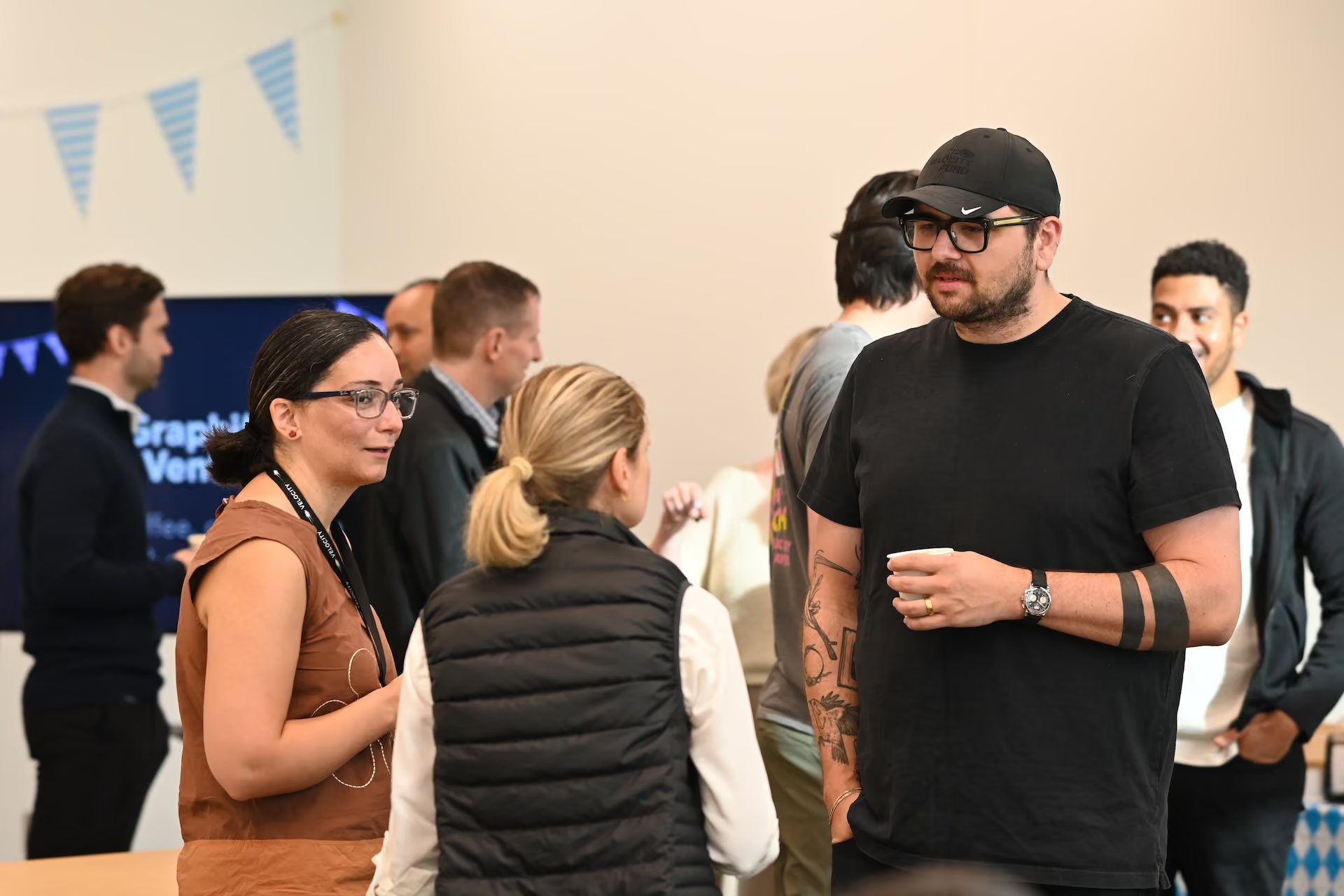
Velocity Fund: Canada's pre-seed fund for founders who move fast.
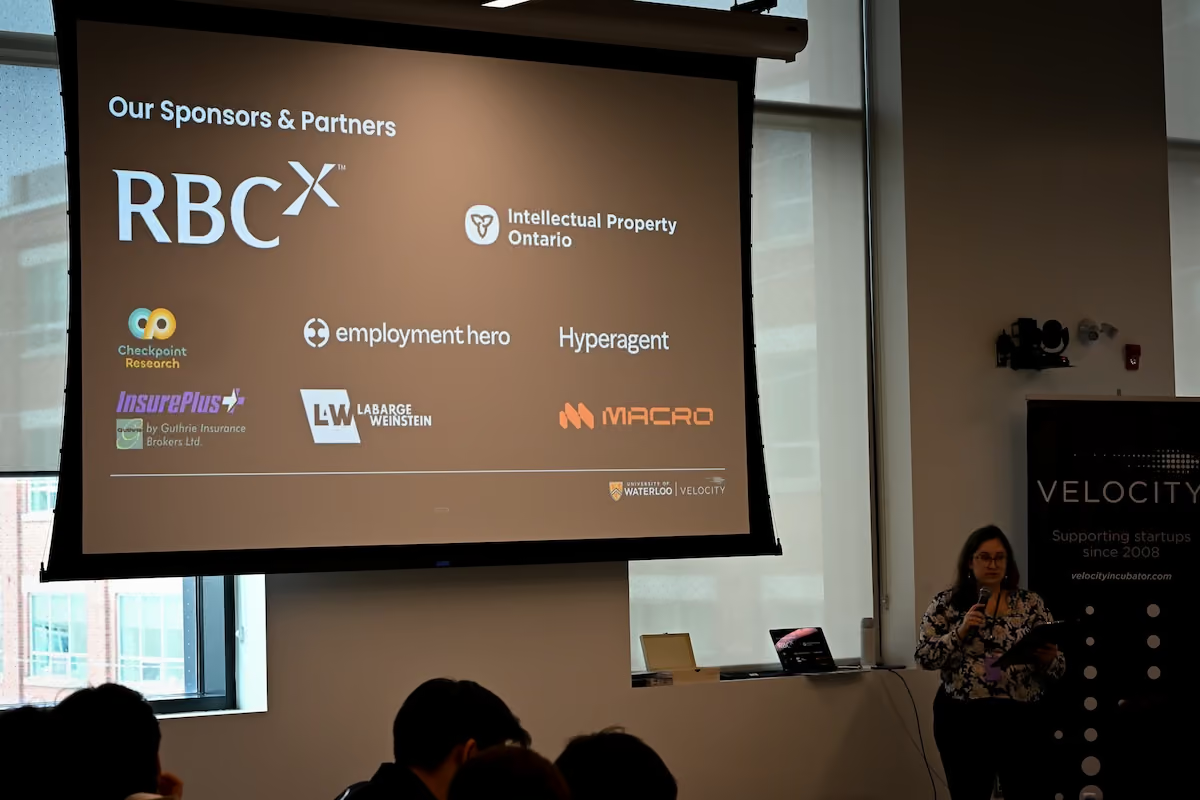
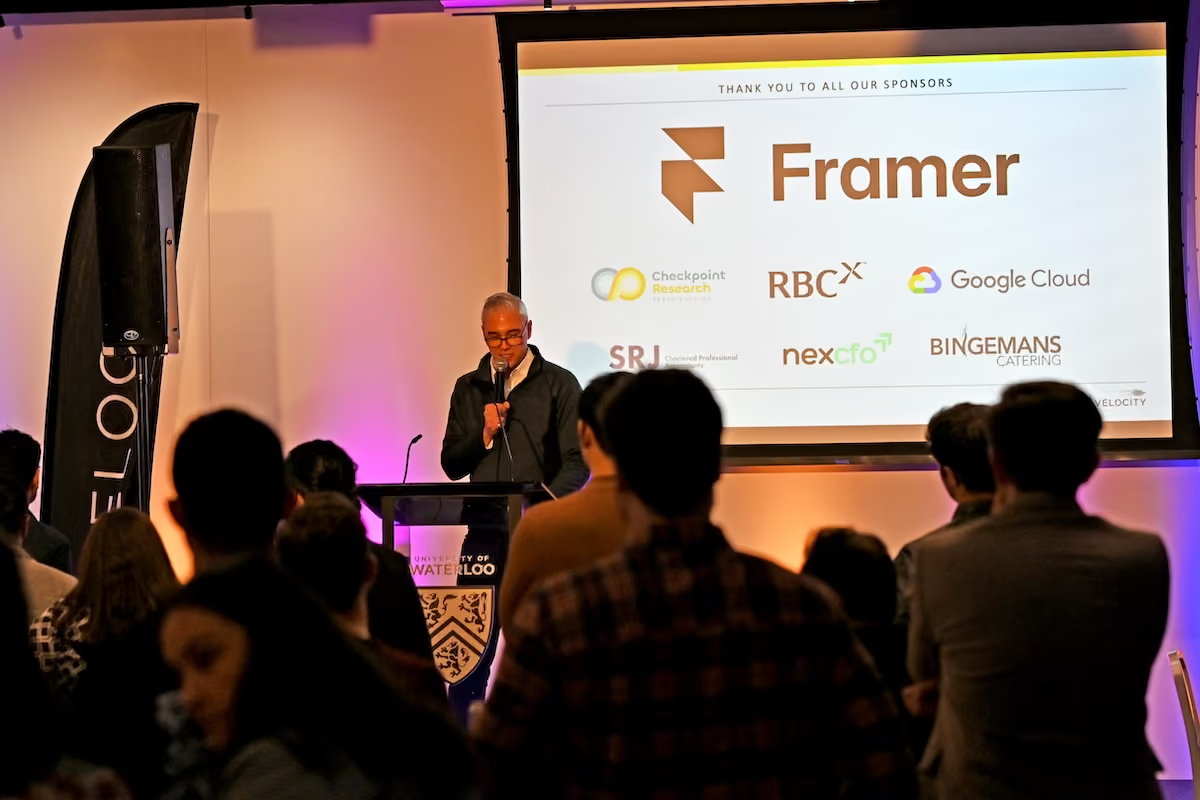
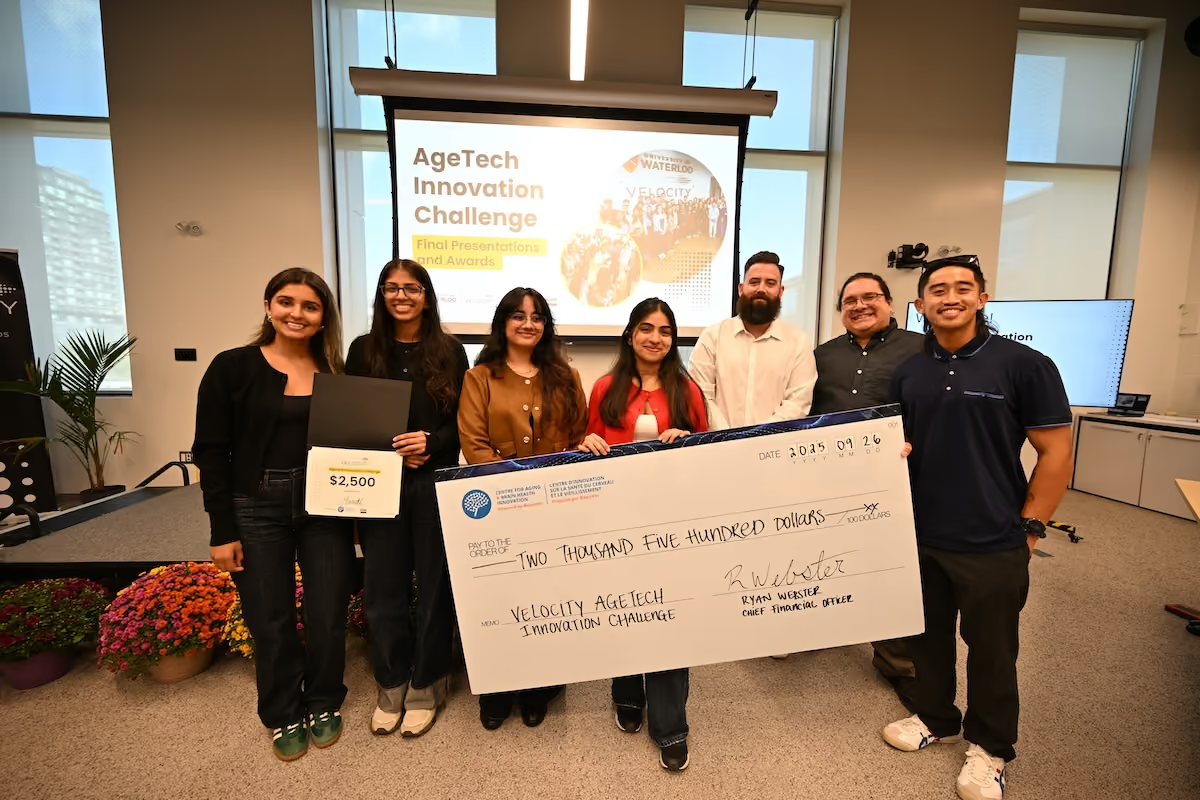
Thank you to our partners and supporters
The founder community thrives because of YOU. You help us do more so founders can do more. From sponsorships that elevate the founder experience to hands-on, practical learning opportunities and office hours, we are grateful you’re a part of the innovation ecosystem at Waterloo.

News highlights
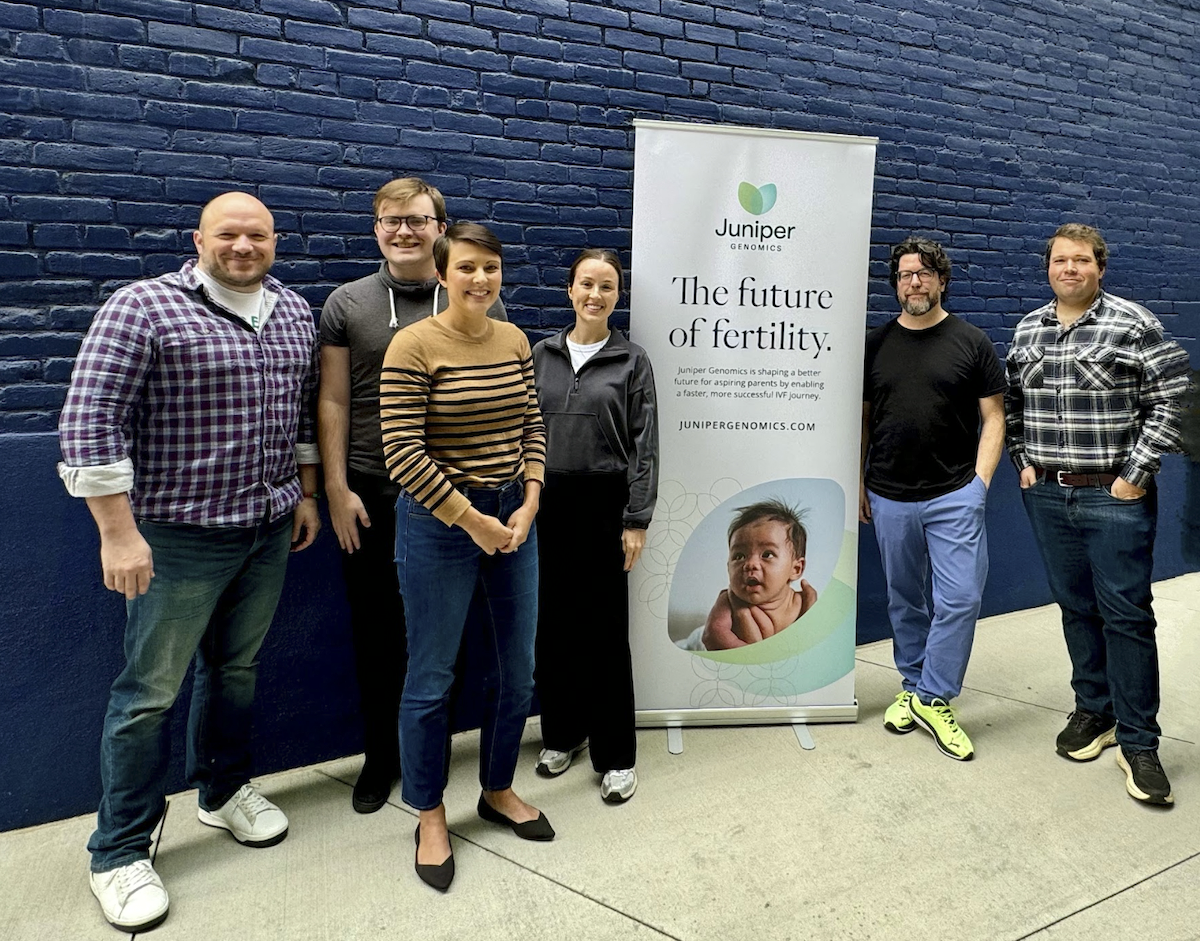
Juniper Genomics raises $4.6M for whole-genome embryo screening platform

Adaptis raises $4 million USD to help building owners meet profitability and sustainability
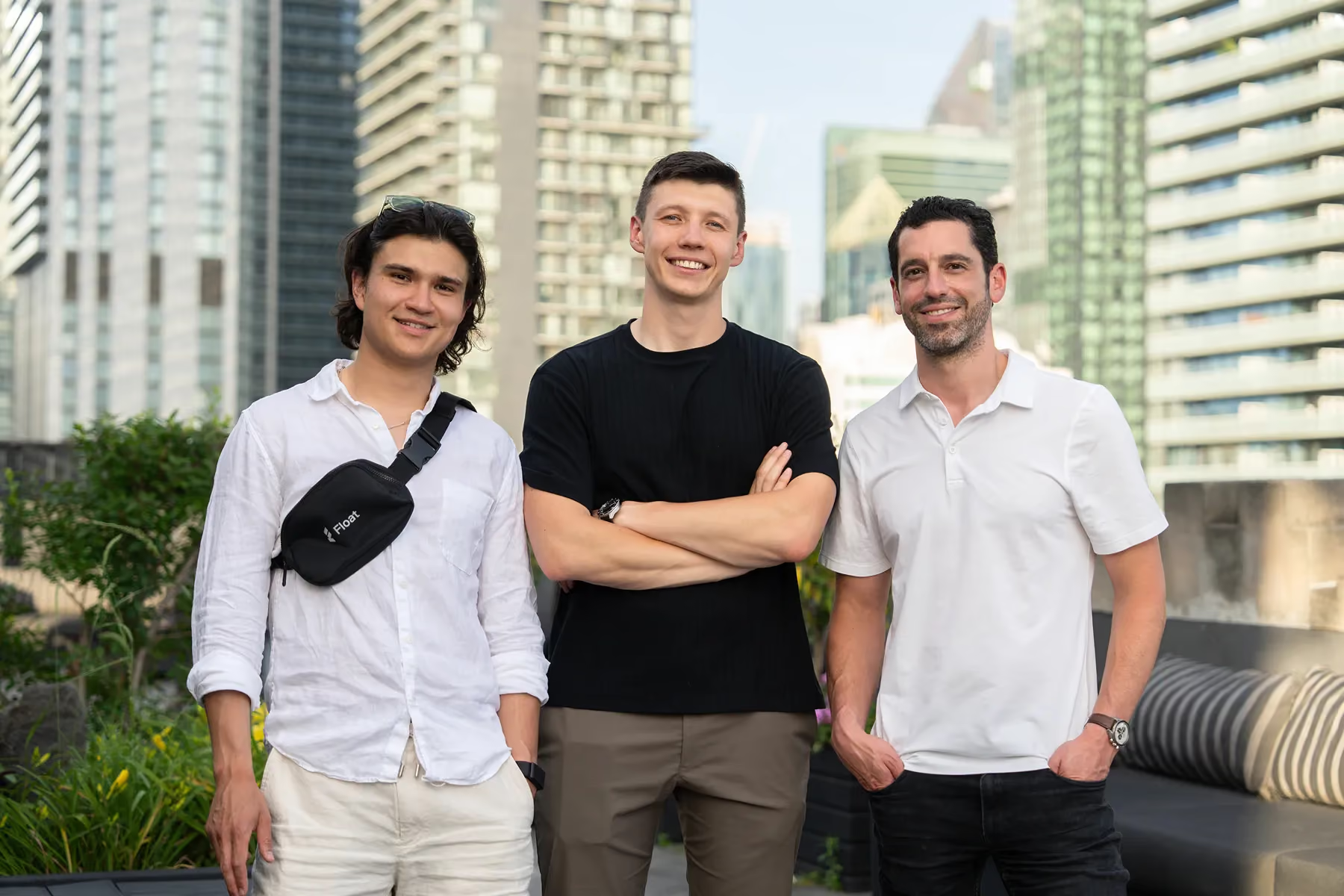
Float raises CAD $85M Series C to build Canada's intelligent financial operating system

OpenPhone rebrands to Quo with $105M financing
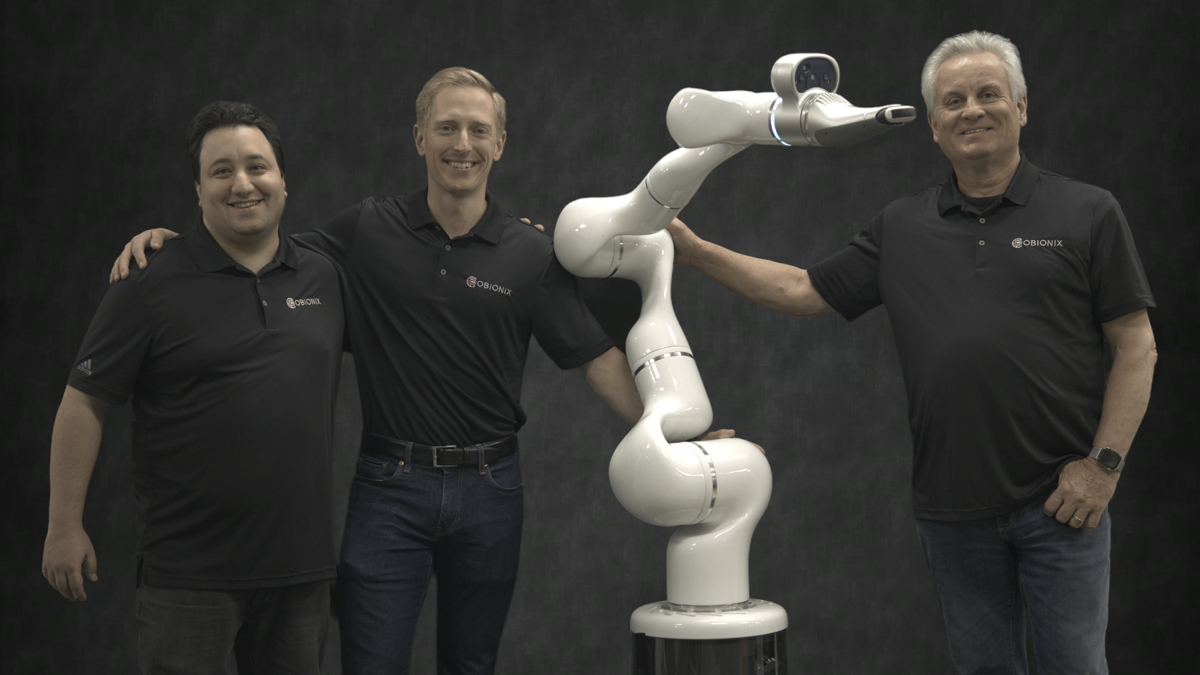
Automating routine health care tasks through robotics takes another decisive step forward
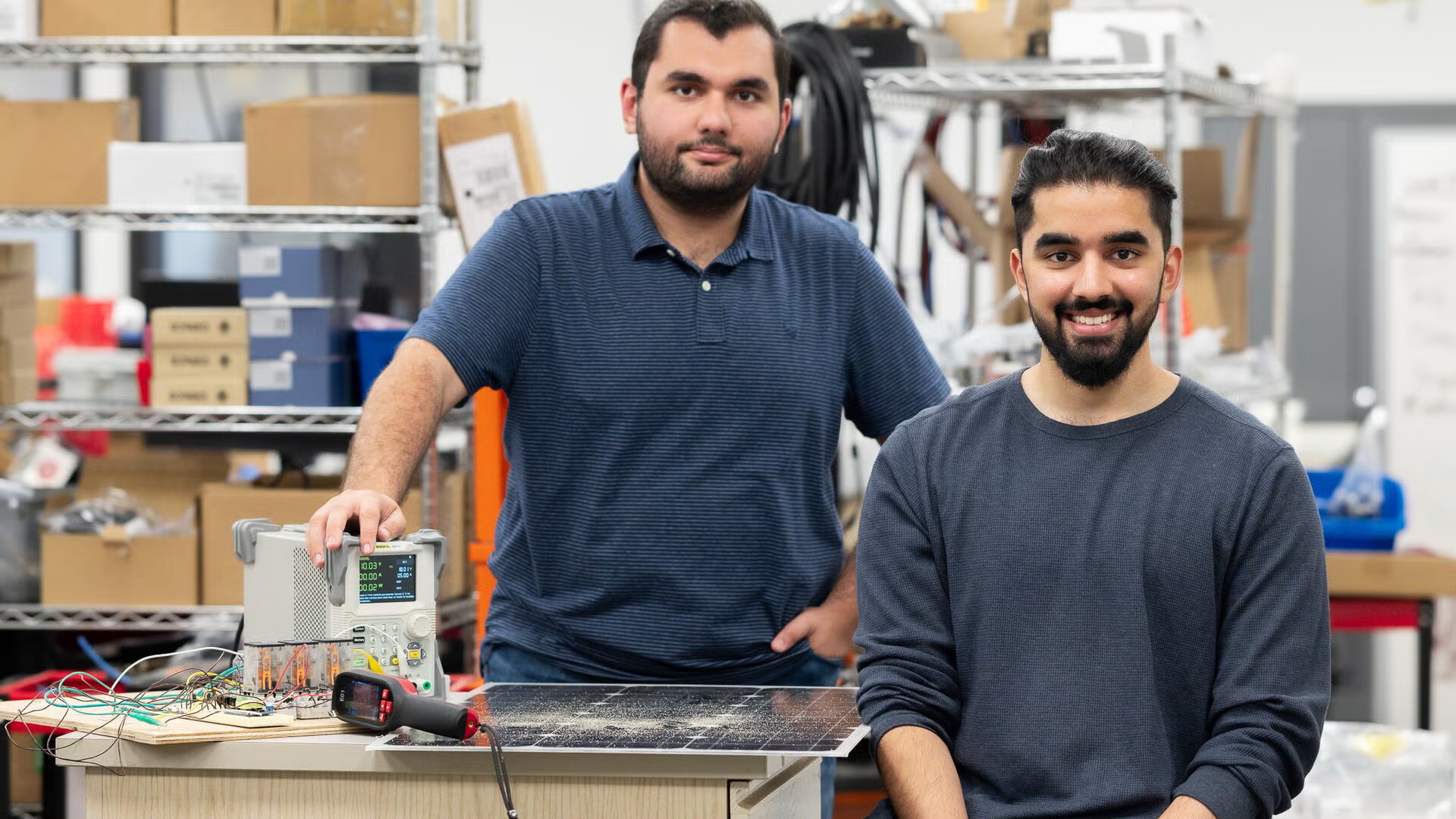
Swish Solar raises US$1.5M to make solar energy more sustainable

$7.5 million seed funding helps Upside Robotics plant the seeds for success

Mappedin raises $24.5M for indoor digital mapping

Alchemy Labs completes IPO, lists on the TSX Venture Exchange

Government of Canada backs Qidni Labs' $25 million push to scale portable dialysis

Palitronica closes Series A to scale physics-based cybersecurity for critical infrastructure

Scispot closes $8-million USD Series A to become the operating layer for life sciences labs